Advances in Engineering Advances in Engineering features breaking research judged by Advances in Engineering advisory team to be of key importance in the Engineering field. Papers are selected from over 10,000 published each week from most peer reviewed journals.

Significance Statement
Electrical engineers at UC San Diego have broken key barriers that limit the distance information can travel in fiber optic cables and still be accurately deciphered by a receiver. The new findings effectively eliminate the need for electronic regenerators placed periodically along the fiber link. This development will significantly change the cost of network infrastructure which will lead to cheaper and also more efficient data transmission.
Figure Legend
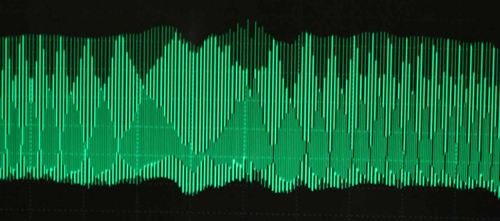
A wideband frequency comb ensures that the crosstalk between multiple communication channels within the same optical fiber is reversible
Journal Reference
E. Temprana1, E. Myslivets1, B.P.-P. Kuo1, L. Liu1, V. Ataie1, N. Alic2, S. Radic1,2. Science, 2015.
[expand title=”Show Affiliations”]1Department of Electrical and Computer Engineering, University of California, San Diego, La Jolla, CA 92093, USA.
2Qualcomm Institute, University of California, San Diego, La Jolla, CA 92093, USA.
[/expand]ABSTRACT
Nonlinear optical response of silica imposes a fundamental limit on the information transfer capacity in optical fibers. Communication beyond this limit requires higher signal power and suppression of nonlinear distortions to prevent irreversible information loss. The nonlinear interaction in silica is a deterministic phenomenon that can, in principle, be completely reversed. However, attempts to remove the effects of nonlinear propagation have led to only modest improvements, and the precise physical mechanism preventing nonlinear cancellation remains unknown. We demonstrate that optical carrier stability plays a critical role in canceling Kerr-induced distortions and that nonlinear wave interaction in silica can be substantially reverted if optical carriers possess a sufficient degree of mutual coherence. These measurements indicate that fiber information capacity can be notably increased over previous estimates.