Advances in Engineering Advances in Engineering features breaking research judged by Advances in Engineering advisory team to be of key importance in the Engineering field. Papers are selected from over 10,000 published each week from most peer reviewed journals.

Lata Ramrakhiani, Rajib Majumder, Suman Khowala
Chemical Engineering Journal, Volume 171, Issue 3, July 2011
Abstract
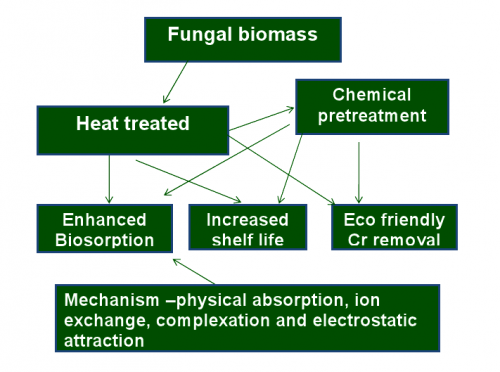
Fungal biomass of Termitomyces clypeatus was pretreated with heat and inactivated, which increased the biosorption efficiency (97.09% in 24h, pH 2.0) as compared to that of live biomass (66.15% in 48h). The heat inactivated biomass was further pretreated with chemicals (acids, alkali and salts), where the biosorption efficiency enhanced with acid pretreatment and reduced by alkali. The pretreatment with CaCl2 increased the biosorption capacity but decreased with NaCl. Chemical pretreatment of Termitomyces clypeatus biomass with acids (HCl, acetic, phosphoric and oxalic), calcium chloride, formaldehyde and ammonium persulfate enhanced the Cr(VI) biosorption efficiency to 100% (at pH 5.0-7.0). The influence of different environmental parameters such as pH, biomass dose, initial Cr concentration, contact time, shake condition on biosorption by the heat treated biomass were investigated. Adsorption characteristics fitted well with Langmuir and Freundlich isotherms and obeyed both the first and the second-order kinetics.
Mechanism of Cr (VI) biosorption by the heat inactivated fungal biomass of Termitomyces clypeatus was studied by analyzing the surface chemistry. Surface chemistry of the biomass was characterized by potentiometric titration, pH of zero charge and SEM-EDX analysis. The acidic and basic sites for the biomass were quantified as 7.75 and 3.25 mmolg-1 respectively, and it was concluded that surface charge of the biomass was acidic. Presence of acidic [carboxyl (pKa 3.45, 4.29), imidazole (pKa 5.98), phosphate (pKa 6.75)] and alkaline [amines (pKa 9.96, 11.92, 12.47), sulfhydryl (thiol) (pKa 8.48), hydroxyl (pKa 11.12)] functional groups were identified and confirmed by FTIR analysis. Chromium biosorption efficiency of the functional groups were found to be in the order as carboxyl>phosphates>lipids> sulfhydryl>amines. Integrative analyses of surface chemistry, functional group modification and FTIR of the biomass showed that the Cr (VI) biosorption involved more than one mechanism such as physical adsorption, ion exchange, complexation and electrostatic attraction. It became apparent that removal of chromium by biosorption took place in two subsequent steps- (i) biosorption of Cr2O7 2- at the protonated active sites (amino, carboxyl and phosphate groups) and (ii) reduction of Cr (VI) to Cr(III) by reducing (hydroxyl and carbonyl) groups on the biomass surface. The pretreated biomass removed Cr and other metals from the tannery effluent to the permissible limit without adjusting the pH. Novelty of the pretreatment was removal of chromium at pH 5 to pH 7, whereas known biosorbents are known to adsorb Cr(VI) only under strong acidic condition (pH 2-4). Heat inactivated biomass was cost effective, ecofriendly and showed efficient chromium removal with no risk of contamination during biosorption process.
Go to Journal