Advances in Engineering Advances in Engineering features breaking research judged by Advances in Engineering advisory team to be of key importance in the Engineering field. Papers are selected from over 10,000 published each week from most peer reviewed journals.

Bala Muhammad, Mohammad Ismail, Muhammad Aamer Rafique Bhutta, Zaiton Abdul-Majid
Construction and Building Materials, Volume 27, Issue 1, February 2012
Abstract
Inclusion of polymeric substances into hydraulic cement concrete has made a tremendous impact towards improving its performance properties. However, polymers to be included into concrete should neither cause damage to its mechanical capacities nor to its durability characteristics. This article reports experimental findings regarding influence of non-hydrocarbon substances present in natural rubber latex (NRL) on the compressive strength of NRL-modified concrete. Six selected clonal latexes were chemically analyzed for thirteen compositional parameters each. The latexes are used in making modified concretes and specimens obtained from these concretes were given both moisture and dry curing treatments for effective cement-hydration and latex-film formations respectively. Eventually, concretes modified with latexes containing higher non-hydrocarbon substances especially volatile fatty acids (VFA) and zinc were observed to suffer significant compressive strength losses. Indeed, 12.4% loss in compressive strength was recorded against concrete modified with the latex having the highest contents of VFA and zinc. However, 2% and 4% increase in the strength over normal concrete were observed in relation to two of the latexes investigated.
Additional Information:
In the process of identifying influence of non-hydrocarbon substances on the compressive strength of natural rubber latex-modified concrete six selected clonal latexes were chemically analyzed for thirteen compositional properties each. The roles of these compositional properties were evaluated through experimental tests. From the assessments, RRIM 2015 and PB 260 emerged the best modifiers. However, modifications with RRIM 926 and RRIM 937 gave the least results. It is quite interesting to note that while the former latexes belong to the latex timber clones, the later were identified as latex clones. Therefore, when it comes to concrete or mortar modifications, first preference should be on latexes obtained from latex timber clones.
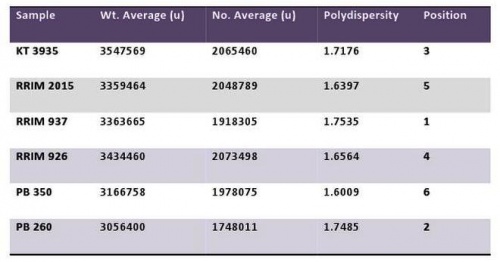
In a further development, polydispersity index (PDI) of the latexes involved in the assessments was also analyzed. Appendix I presents tabulated results of the PDI and position of the individual latexes based on the magnitude of the PDI. Meanwhile, analysis of the results has shown that there is no evidence of any significant role played by the PDI on the compressive strength of the concrete.
APPENDIX I
Go to Journal