 Advances in Engineering Advances in Engineering features breaking research judged by Advances in Engineering advisory team to be of key importance in the Engineering field. Papers are selected from over 10,000 published each week from most peer reviewed journals.

Md. Sayem Hossain Bhuiyan, Imtiaz Ahmed Choudhury, Nukman Yusoff
The International Journal of Advanced Manufacturing Technology, Volume 61, Issue 5-8, July 2012
Abstract
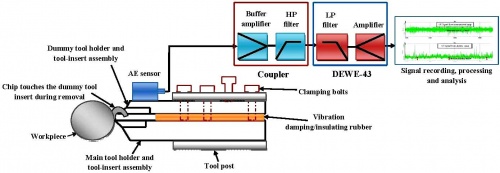
The industrial demand for automated machining systems to enhance process productivity and quality in machining aerospace components requires investigation of tool condition monitoring. The formation of chip and its removal have a remarkable effect on the state of the cutting tool during turning. This work presents a new technique using acoustic emission (AE) to monitor the tool condition by separating the chip formation frequencies from the rest of the signal which comes mostly from tool wear and plastic deformation of the work material. A dummy tool holder and sensor setup have been designed and integrated with the conventional tool holder system to capture the time-domain chip formation signals independently during turning. Several dry turning tests have been conducted at the speed ranging from 120 to 180 m/min, feed rate from 0.20 to 0.50 mm/rev, and depth of cut from 1 to 1.5 mm. The tool insert used was TiN-coated carbide while the work material was high-carbon steel. The signals from the dummy setup clearly differ from the AE signals of the conventional setup. It has been observed that time-domain signal and corresponding frequency response can predict the tool conditions. The rate of tool wear was found to decrease with chip breakage even at higher feed rate. The tool wear and plastic deformation were viewed to decrease with the increased radius of chip curvature and thinner chip thickness even at the highest cutting speed, and these have been verified by measuring tool wear. The chip formation frequency has been found to be within 97.7 to 640 kHz.
Additional information:
A dummy tool holder assisted tool condition monitoring using AE sensor is a new approach and it has the potential to monitor the tool during cutting. It is capable of investigating the different occurrences independently according to their signal frequency. The dummy tool holder set-up essentially captures the chip formation signal and its effect on the total signal is visible and separable. The rates of plastic deformation of workmaterial and tool wear have collectively been represented by the amplitude and frequencies of signal components remaining below the offset signal where the offset signal is acquired from the dummy set-up representing the chip formation. With the drop of amplitude in the chip formation frequency, the band remaining below the offset signals also shrinks indicating a reduction in plastic deformation of the workmaterial and tool wear rate. The dummy set-up has expedited to predict tool wear progression successfully. The next challenge is to separate the frequency of plastic deformation from the tool wear so that tool condition monitoring becomes much more effective and meaningful.