Advances in Engineering Advances in Engineering features breaking research judged by Advances in Engineering advisory team to be of key importance in the Engineering field. Papers are selected from over 10,000 published each week from most peer reviewed journals.

Lyubka M. Spasova, Michael I. Ojovan, Fergus G.F. Gibb
Nuclear Engineering and Design, Volume 248, July 2012
Abstract
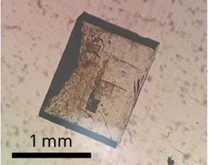
Acoustic emission (AE) signals resulting from the melting and solidification of natural granite were monitored and analysed. The experimental work was conducted in laboratory conditions simulating very deep borehole disposal (DBD) of high level wastes such as sealed radioactive sources (SRS) or spent nuclear fuel (SNF). The cumulative number of signals, their durations and frequencies were the main characteristics of the monitored processes. The recorded AE could be associated with the complex changes in volume and shape of the constituent minerals associated with solid–liquid and solid–solid phase transformations within the granite. AE from the granite was also studied in part by monitoring phase transformation on heating and cooling of quartz.
The results in our publication “Acoustic emission on melting/solidification of natural granite” [1] are the first experimental evidences which can lead to innovative approaches in geological survey as well as engineering and disposal of highly radioactive nuclear wastes.
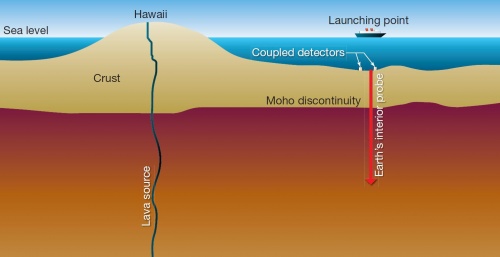
Similar approach for melting of rock by radiogenic heat followed by solidification/recrystallisation of the melt, as described in our paper, is a part of the “deep self-burial” scheme for nuclear waste. It is intended to place the radioactive sources inside of self-sinking metallic capsules which melt their way penetrating in very deep layers within the Earth as shown in Figure 1. Moreover, the self-sinking capsules have also been proposed to explore the structure of the Earth’s crust and mantle. According to calculations, detailed in a recent paper [2], a tungsten sphere with a diameter of 1 m, containing short-lived radionuclides such as 60Co will be able to reach the Earth’s mantle to a depth of 100 km in ~35 years. Acoustic emission signals, generated as a result of melting and solidification/recrystallisation of the granite around and behind the capsule, “possibly enhanced by neutron and other radiation effects”, can serve as a “communication link” to trace the sinking capsule and therefore to obtain additional information on the structure of the Earth.
[1] L.M. Spasova, M.I. Ojovan, F.G.F. Gibb. Acoustic emission on melting/solidification of natural granite simulating very deep waste disposal.Nuclear Engineering and Design,248, 329-339 (2012). [2] M. Ojovan, P. Poluektov, V. Kascheev. The self-disposal option.Nuclear Engineering International, 57 (696) 28-29 (2012).Go to Journal