Advances in Engineering Advances in Engineering features breaking research judged by Advances in Engineering advisory team to be of key importance in the Engineering field. Papers are selected from over 10,000 published each week from most peer reviewed journals.

Chi-Ming Chu, Md. Mizanur Rahman, Sivakumar Kumaresan
Nuclear Engineering and Design, Volume 249, August 2012
Abstract
Temperature and pressure drop data obtained from an air-cooled heat exchanger model with cross-sectional flow areas of 0.56 m2, 1.00 m2 and 2.25 m2 operating under natural convection are presented that indicate significant cold inflow, resulting in the reduction of effective chimney height. Cold inflows encountered in actual applications where the Froude number is typically 0.2, may not be as severe as described in this paper, which was of the order of 10−6–10−4. Additional tests on smaller scale models appeared to favor the explanation that the occurrence of cold inflow in the air-cooled heat exchanger model was primarily due to the relative ease in either drawing cold air from inlet or from outlet, and to a lesser extent the Froude number of the chimney or the critical velocity estimated by Jörg and Scorer’s (1967) formula. A CFD study will bring much understanding of the phenomenon for the different situations.
TURBO-CHARGED CHIMNEYS USING WIRE MESH
In a natural draft air cooled heat exchanger or cooling tower, the hot air continuously flows in the upward direction and the cold air enters from the bottom. The airflow is due solely to local buoyancy differences caused by the presence of temperature difference between process side and ambient, in contrast to forced convection process, where a fan is placed either at the bottom or above the tube bundle to increase airflow rate to remove waste heat. In certain applications, a natural draft air cooled heat exchanger has the advantage in terms of operational safety and reliability. The utilisation of the natural buoyancy of hot air to generate draft which cools the tube bundle means that energy and water can be saved in the process, and this is generally useful in countries where energy and water resources are scarce, for example the Middle East, Australia and South Africa.
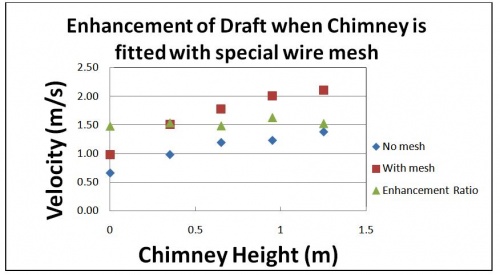
Whether the field is cooling tower or solar chimney or vertical channel cooling, a commonly acknowledged problem is that they experience unstable flow with breezes leading to undesirable down draft. Wire mesh-fitted chimneysof 0.56 m2, 1.0 m2 and 2.25 m2 face area demonstrated that enhancement of draft recorded was between 40% to 90% more than when the chimney was unmodified. This enhancement was confirmed by CFD study and smoke flow visualization that showed cold air bouncing above the wire mesh at exit instead of sinking into the chimney.
Potential applications range from ventilation e.g. passive cooling of buildings and data centers, drying of biomass or farm produce, enhanced air circulation and conversion of thermal energy into mechanical energy like solar chimney power plants. A patent has been filed for the new chimney system fitted with such wire mesh.
Go to Journal