Advances in Engineering Advances in Engineering features breaking research judged by Advances in Engineering advisory team to be of key importance in the Engineering field. Papers are selected from over 10,000 published each week from most peer reviewed journals.

Massimo Camarda
Surface Science, Volume 606, Issues 15–16, August 2012
Abstract
In this article we use three dimensional kinetic Monte Carlo simulations on super-lattices to study the hetero-polytypical growth of cubic silicon carbide polytype (3C-SiC) on misoriented hexagonal (4H and 6H) substrates. We analyze the quality of the 3C-SiC film varying the polytype, the miscut angle and the initial surface morphology of the substrate. We find that the use of 6H misoriented (4°–10° off) substrates, with step bunched surfaces, can strongly improve the quality of the cubic epitaxial film whereas the 3C/4H growth is affected by the generation of dislocations, due to the incommensurable periodicity of the 3C (3) and the 4H (4) polytypes. For these reasons, a proper pre-growth treatment of 6H misoriented substrates can be the key for the growth of high quality, twin free, 3C-SiC films.
Additional Information:
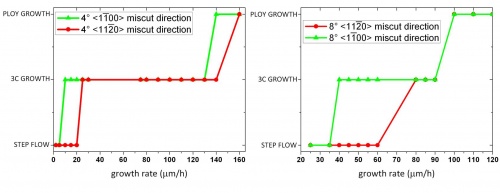
In this article we use three dimensional kinetic Monte Carlo simulations on super-lattices to study the heteropolytypicalgrowth of cubic silicon carbide polytype (3C-SiC) on misoriented hexagonal (4H and 6H) substrates.We analyze the quality of the 3C-SiC film varying the polytype, the miscut angle and the initial surfacemorphology of the substrate. We find that the use of 6H misoriented (4°–10° off) substrates, with stepbunched surfaces, can strongly improve the quality of the cubic epitaxial film whereas the 3C/4H growth isaffected by the generation of dislocations, due to the incommensurable periodicity of the 3C (3) and the4H (4) polytypes. Furthermore we tested 3C conversion on two different miscut directions, namely the <11-20> (the standard, most used, one) and the <1-100> ones, finding that the latter one can improve the conversion (specifically, increase the extension of the 3C-conversion in terms of allowed growth rates). For these reasons, the use of proper pre-growth treatments (to induce step bunching), high growth rates (to hinder step-flow growths) and (1.5°-8°) degree off <1-100>misoriented6H substrates can bethe keys for the growth of high quality, twin free, 3C-SiC films.
Go to Journal