Advances in Engineering Advances in Engineering features breaking research judged by Advances in Engineering advisory team to be of key importance in the Engineering field. Papers are selected from over 10,000 published each week from most peer reviewed journals.

Microelectronics Reliability, Volume 52, Issues 9–10, September–October 2012, Pages 2294-2300
X. Perpinà, R. Werkhoven, J. Jakovenko, J. Formanek, M. Vellvehi, X. Jordà, J. Kunen, P. Bancken, P.J. Bolt
Centre Nacional de Microelectrònica, IMB-CNM(CSIC), Campus UAB, 08193 Bellaterra, Barcelona, Spain
TNO, PO Box 6235, 5600 HE Eindhoven, The Netherlands
Department of Microelectronics, Czech Technical University in Prague, Czech Republic
Philips Lighting, Lightlabs, Mathildelaan 1, 5611 BD Eindhoven, The Netherlands
Abstract
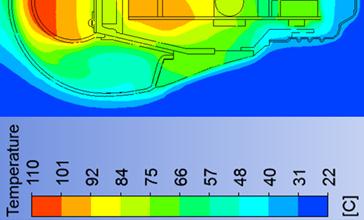
This work presents a methodology to design an SSL system for reliability. An LED lamp is thermally characterised and its model thermally simulated, indicating that the LED board (FR4 board with thermal vias, copper tracks and LED package) is the thermally most stressed part. Therefore, a thermo-mechanical analysis is performed from a detailed LED board model to study reliability and lifetime limits, using thermal boundary conditions deduced from the thermal simulation of the whole LED lamp. Based on this analysis the weakest spots are identified as the metal vias in the LED package and the interconnection area between the LED package and copper tracks on the FR4 board.
Additional Information
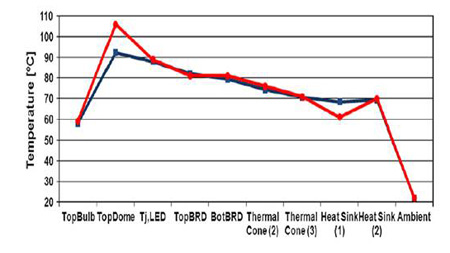
This work carries out a study into the thermo-mechanical influence of the thermally most stressed parts of an LED lamp by means of simulation. First, full thermal characterization of an LED lamp and its driver board is carried out by infrared thermography and by monitoring specific locations with thermocouples. The experimental results have been used to set up and validate a predictive simulation model for both the LED lamp and the LED board. Thermal simulation of the driver board using a simplified model of the board with electrical components results in reasonable agreement with the measured temperatures. When placing the driver board inside the LED lamp, a significant increase in driver board temperatures is found in all LED lamp parts (e.g. up to 15% for LED board), according to both measurements and simulations. This will affect the reliability of the most critical elements of the lamp: driver board components and LED board.
From experimental results it is observed that driver board components are below their operating limits. Reliability problems and lifetime expectancy limits will arise from the LED board ageing. For this reason, in more depth thermo-mechanical analyses are carried out for three case studies: at low temperature (-40 ºC, minimum value of thermal cycling tests), at room temperature (22 ºC), and under working conditions (representative for power cycling tests). The thermal stresses were calculated by a static thermal–mechanical analysis with nonlinear elastic–plastic material behavior.
To verify lifetime expectancy a test has been performed which applies a periodic mechanical load at the centre of an LED board. With this test set-up the LED board lifetime can be studied. As a result, the paper concludes that metal vias of the LED package and the interconnection area contacting the LED package with the copper tracks of the LED board are identified as the weakest spots. To increase the life time of the LED board efforts should be invested in optimising these parts. Other benefits of the presented approach are: (i) predicting the temperature increase on a driver or LED board, (ii) access the potential of other thermal management or thermo-mechanical solutions than adopted for an already existing LED lamp, and (iii) to design a new LED lamp for reliability.