Advances in Engineering Advances in Engineering features breaking research judged by Advances in Engineering advisory team to be of key importance in the Engineering field. Papers are selected from over 10,000 published each week from most peer reviewed journals.

ACS Nano 2012;6(8):7443-7453.
Xiaojun Wu; Jun Dai; Yu Zhao; Zhiwen Zhuo; Jinlong Yang; Xiao Cheng Zeng
Abstract
Boron, a nearest-neighbor of carbon, is possibly the second element that can possess free-standing flat monolayer structures, evidenced by recent successful synthesis of single-walled and multiwalled boron nanotubes (MWBNTs). From an extensive structural search using the first-principles particle-swarm optimization (PSO) global algorithm, two boron monolayers ({Alpha} 1 – and {Beta} 1 -sheet) are predicted to be the most stable {Alpha}- and {Beta}-types of boron sheets, respectively. Both boron sheets possess greater cohesive energies than the state-of-the-art two-dimensional boron structures (by more than 60 meV/atom based on density functional theory calculation using PBE0 hybrid functional), that is, the {Alpha}-sheet previously predicted by Tang and Ismail-Beigi and the g 1/8 – and g 2/15 -sheets (both belonging to the {Beta}-type) recently reported by Yakobson and co-workers. Moreover, the PBE0 calculation predicts that the {Alpha}-sheet is a semiconductor, while the {Alpha} 1 -, {Beta} 1 -, g 1/8 -, and g 2/15 -sheets are all metals. When two {Alpha} 1 monolayers are stacked on top each other, the bilayer {Alpha} 1 -sheet remains flat with an optimal interlayer distance of ∼3.62 Å, which is close to the measured interlayer distance (∼3.2 Å) in MWBNTs. © 2012 American Chemical Society.
Additional Information
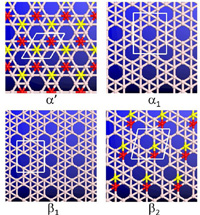
Among known chemical elements in nature, few can exhibit multiple forms of low-dimensional allotropic structures, such as 0D cage molecules, 1D nanotubes, or 2D sheets. Carbon is an exception as all three low-dimensional allotropes of carbon, including 0D fullerenes, 1D carbon nanotubes, and 2D graphene monolayer sheet have been isolated in the laboratory. Boron is possibly the second element that can possess multiple low-dimensional allotropes. In a recent article [ACS Nano 6, 7443 (2012)], Wu, Zeng and coworkers reported an extensive search of lowest-energy structures of 2D monolayer boron sheets. Among newly predicted highly stable boron sheets, three belong to the so-called a-type (that is, the coordination number of every boron atom is either 4 or 5), while five belong to the b-type (that is, the coordination number of every boron atom is either 4, or 5 or 6). In the b group, b4 and b5 have been reported previously by Yakobson and coworkers [Nano Letters 12, 2441 (2012)]. Because at least five or six boron sheets are nearly degenerate in energy, one must await high-resolution TEM measurement to resolve the atomic structures of 2D boron sheets or 1D single-walled boron nanotubes and determine whether some of these boron sheets (polymorphs) can be equally stable or coexist. In addition, Wu, Zeng and coworkers find that among the half dozen iso-energetic boron sheets, the {Alpha}′-sheet (see figure below) is semiconducting, while others are all metallic. This conclusion will be useful to the experimentalists for detecting electronic properties boron sheets once 2D monolayer boron sheets could be isolated in the laboratory.