Advances in Engineering Advances in Engineering features breaking research judged by Advances in Engineering advisory team to be of key importance in the Engineering field. Papers are selected from over 10,000 published each week from most peer reviewed journals.

Stock E, Albert F, Hopfmann C, Lermer M, Schneider C, Hofling S, Forchel A, Kamp M, Reitzenstein S.
Adv Mater. 2013 Feb 6;25(5):707-10.
Institut fur Festkorperphysik, Technische Universitat Berlin, Hardenbergstraße 36, D-10623 Berlin, Germany.
Abstract
A novel concept for on-chip quantum optics using an internal electrically pumped microlaser is presented. The microlaser resonantly excites a quantum dot microcavity system operating in the weak coupling regime of cavity quantum electrodynamics. This work presents the first on-chip application of quantum dot microlasers, and also opens up new avenues for the integration of individual microcavity structures into larger photonic networks.
Copyright © 2013 WILEY-VCH Verlag GmbH & Co. KGaA, Weinheim.
Additional Information
The exciting advances in semiconductor nanotechnology have paved the way for novel device concepts relying on effects governed by quantum mechanical phenomena. A driving force in this field is the development of building blocks for future quantum information technology. For instance, non-classical semiconductor based light sources such as structures emitting single photons or entangled photon pairs on demand are highly interesting for applications in the field of secure quantum communication.
Semiconductor quantum devices are almost exclusively based on self-assembled quantum dots (QDs) which are tiny nanocrystals with superb optical properties and an atom-like emission spectrum. To further enhance their emission features in terms of the emission rate and directionality they are typically integrated into high quality micro- or nanocavities with mode volumes on the order of, or below the cube-wavelength of the confined light. The advances in this field have been breathtaking in recent years, however, they have also been limited basically to single structures excited via external lasers, and the integration single entities into larger networks of coupled microcavities has been hindered by the lack of suitable on-chip microlasers.
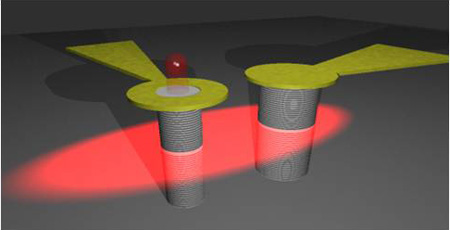
In the present work, we developed a fully integrated electrically driven quantum device to further boost the application quantum dot – microcavities in the field of quantum information technology and quantum optics in solid state. The underlying concept takes advantage of the unique properties of micropillar cavities: They can be electrically driven in a straight-forward way and show both, emission in vertical direction via standard waveguide modes and in-plane emission via whispering gallery modes (WGMs). We take advantage of this features by using coherent light from an electrically driven WGM-microlaser with a threshold current in the µA-range to optically excite a target QD embedded into a second micropillar located 10 µm away. This QD experiences pronounced Purcell-enhancement of emission due to its interaction with the optical mode of the micropillar. This result is considered the first fully integrated on-chip quantum optics experiment and can be the basis for monolithic electrically driven and controlled nanophotonics networks.
Ongoing work focusses on directional in-plane emission from the WGM-microlaser to couple its emission into planar waveguide structures and efficiently excite integrated sources of indistinguishable photons and entangled photon pairs. The corresponding device concept is schematically shown in the figure below. Here, directional emission from the integrated microlaser has already been achieved in microlasers with Limaçon-shaped cross-section (F. Albert et al., Appl. Phys. Lett. 101, 02116 (2012)).