Advances in Engineering Advances in Engineering features breaking research judged by Advances in Engineering advisory team to be of key importance in the Engineering field. Papers are selected from over 10,000 published each week from most peer reviewed journals.

Significance Statement
Over the recent years, there is a trend in electronics towards becoming shapeable (flexible, stretchable or printable), which provides unique advantages of being lightweight and allows electronic components to be arbitrarily reshaped after fabrication. This vision however will become reality only when all branches of modern electronics, including optoelectronics and magnetoelectronics, will gain the attractive property of being shapeable. Smart combination of magnetic multilayers revealing giant magneto-resistance and thin polymer membranes results in a shapeable magnetoelectronics. This shapeable (stretchable [1-3] or printable [4]) magnetoelectronics paves the way towards development of a unique class of devices with important functionality being not only stretchable and fast, but also with the ability to react and respond to a magnetic field.
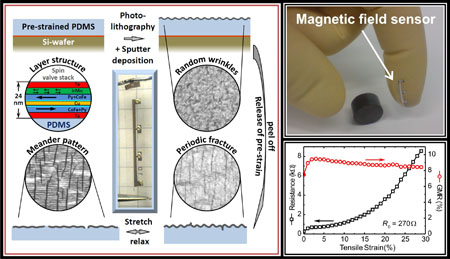
Layered magnetic structures revealing a giant magnetoresistance (GMR) effect are crucial components of highly sensitive magnetic sensor devices. We fabricated [Co/Cu] and [Py/Cu] GMR multilayers [1,2] as well as spin valve systems [3] on free-standing elastic Poly(dimethylsiloxane) (PDMS) membranes. The GMR performance of GMR sensors on rigid silicon and on free-standing PDMS is similar and does not change with tensile deformations.
In this work we realize the first stretchable spin valve sensor with a remarkable stretchability of up to 29% and a top sensitivity of 0.8 % Oe-1 in the magnetic field of 12 Oe [3]. We developed a technology to successfully accomplish this task by using a spin valve magnetic sensor as it is an advanced GMR-based element and by applying a predetermined periodic fracture method to enhance the stretchability. These highly stretchable and highly sensitive elements responding to a magnetic field are demanded for novel application fields like smart skin and flexible and stretchable consumer electronics equipped with magnetic functionalities.
Journal Reference
Melzer M, Lin G, Makarov D, Schmidt OG. Adv Mater. 2012 Dec 18;24(48):6468-72.
Institute for Integrative Nanosciences, IFW Dresden, Helmholtzstraße 20, Dresden 01069, Germany. [email protected].
Abstract
The first highly stretchable and sensitive spin valve sensor on elastomeric membranes are demonstrated. The sensor elements exhibit stable GMR behavior up to tensile strains of 29% in in situ stretching experiments and show no fatigue over 500 loading cycles. This remarkable stretchability is achieved by a predetermined periodic fracture mechanism that creates a meander-like pattern upon stretching.
Copyright © 2012 WILEY-VCH Verlag GmbH & Co. KGaA, Weinheim.