Advances in Engineering Advances in Engineering features breaking research judged by Advances in Engineering advisory team to be of key importance in the Engineering field. Papers are selected from over 10,000 published each week from most peer reviewed journals.

Applied Physics A, February 2013, Volume 110, Issue 2, pp 281-307
Samuel Rosset, Herbert R. Shea.
Ecole Polytechnique Fédérale de Lausanne (EPFL), Jaquet-Droz 1, 2002, Neuchatel, Switzerland.
Abstract
Dielectric elastomer actuators (DEAs) are flexible lightweight actuators that can generate strains of over 100 %. They are used in applications ranging from haptic feedback (mm-sized devices), to cm-scale soft robots, to meter-long blimps. DEAs consist of an electrode-elastomer-electrode stack, placed on a frame. Applying a voltage between the electrodes electrostatically compresses the elastomer, which deforms in-plane or out-of plane depending on design. Since the electrodes are bonded to the elastomer, they must reliably sustain repeated very large deformations while remaining conductive, and without significantly adding to the stiffness of the soft elastomer. The electrodes are required for electrostatic actuation, but also enable resistive and capacitive sensing of the strain, leading to self-sensing actuators. This review compares the different technologies used to make compliant electrodes for DEAs in terms of: impact on DEA device performance (speed, efficiency, maximum strain), manufacturability, miniaturization, the integration of self-sensing and self-switching, and compatibility with low-voltage operation. While graphite and carbon black have been the most widely used technique in research environments, alternative methods are emerging which combine compliance, conduction at over 100 % strain with better conductivity and/or ease of patternability, including microfabrication-based approaches for compliant metal thin-films, metal-polymer nano-composites, nanoparticle implantation, and reel-to-reel production of um-scale patterned thin films on elastomers. Such electrodes are key to miniaturization, low-voltage operation, and widespread commercialization of DEAs.
Figure Legend
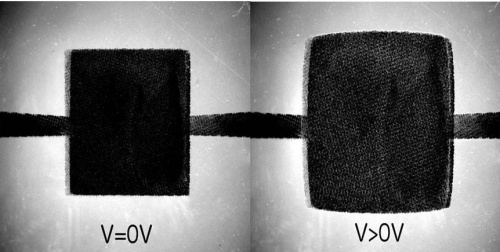
Compliant electrode for Dielectric Elastomer Actuators must meet different criteria in such as remaining conductive while stretched and not adding to the stiffness of the thin elastomeric membrane on which they are patterned. Only very soft electrodes can lead to large area strain when activated. The most common type of compliant electrodes are based on carbon particles: either loose powder (Carbon black), or carbon grease, or carbon mixed in an elastomeric matrix. However, carbon electrodes suffer from shortcomings such as low reliability and life time. Other type of very compliant electrodes have been proposed, such as corrugated metal thin-films, metal ion implantation, silver nanowires, etc. The picture shows a 60% surface increase of carbon rubber (Carbon black in elastomer matrix) applied on a thin silicone membrane.