Advances in Engineering Advances in Engineering features breaking research judged by Advances in Engineering advisory team to be of key importance in the Engineering field. Papers are selected from over 10,000 published each week from most peer reviewed journals.

Microelectronic Engineering, 26 February 2013
Y. Sun, H.Y. Wang, T. Xiong, P.K. Chu, C.W. Leung.
Department of Applied Physics, Hong Kong Polytechnic University, Hung Hom, Hong Kong, China.
Department of Physics and Materials Science, City University of Hong Kong, Tat Chee Avenue, Kowloon Tong, Hong Kong, China.
Abstract
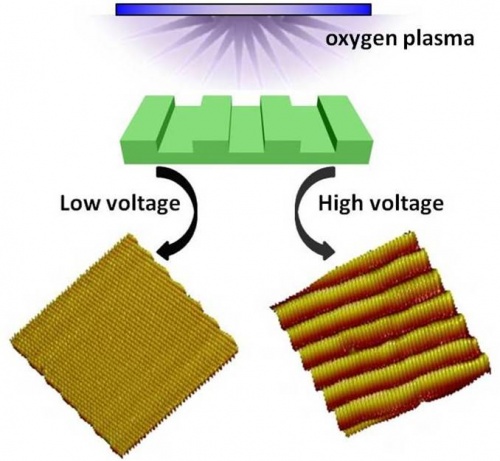
Oxygen plasma ion implantation on the common elastomer polydimethylsiloxane (PDMS) can induce wrinkled and disordered surface morphologies. Here we present a convenient approach of generating (sub)micron-sized features, in order to control the development of such ripple-like features during plasma treatment process. The correlations between the spontaneous patterns with different surface treatment conditions, such as plasma bias voltage and processing time, as well as the effect of surface prepatterns, were studied. The presence of prepatterns suppressed the formation of ripples on the implanted PDMS surfaces, which is advantageous for eliminating the rough surface topologies induced in plasma-treated samples.