Advances in Engineering Advances in Engineering features breaking research judged by Advances in Engineering advisory team to be of key importance in the Engineering field. Papers are selected from over 10,000 published each week from most peer reviewed journals.

Dyes and Pigments, Volume 97, Issue 2, May 2013, Pages 347-352.
Alina Iovescu, Monika Gosecka, Teresa Basinska, Adriana Bãran, Gabriela Stîngã, Stanislaw Slomkowski, Dan Florin Anghel
Laboratory of Colloids, “Ilie Murgulescu” Institute of Physical Chemistry, Romanian Academy, Spl. Independentei 202, Sector 6, 060021 Bucharest, Romania
Department of Engineering of Polymer Materials, Center of Molecular and Macromolecular Studies, Polish Academy of Sciences, ul. H. Sienkiewicza 112, 90-363 Lodz, Poland
Abstract
Emulsion copolymerization of hydrophilic {Alpha}–tert-butoxy-ω-vinylbenzyl-polyglycidol macromonomer with styrene yields core–shell microspheres and a water-soluble copolymer fraction. This copolymer has a higher content of hydrophilic polyglycidol attested by 1H NMR. Further information is acquired by labeling the copolymer with 5-(4,6-dichlorotriazinyl)aminofluorescein (DTAF) and making absorption and fluorescence studies. The acquired data on aqueous solution of labeled copolymer without (L) and with micelles of dodecyltrimethylammonium chloride (LD), sodium dodecylsulfate (LS) and hexaethyleneglycol mono n-dodecyl ether (LE) reveal that the dianionic and anionic tautomers of the DTAF-label are apparent and concordant with the recorded spectrophotometric pKa values. The emission intensities, quantum yields and lifetimes obey the sequence LE < LS < L < LD. They are along with the increasingly deprotonated forms of the fluorophore and unveil that the micelle-label interactions depend on the surfactant.
Additional Information
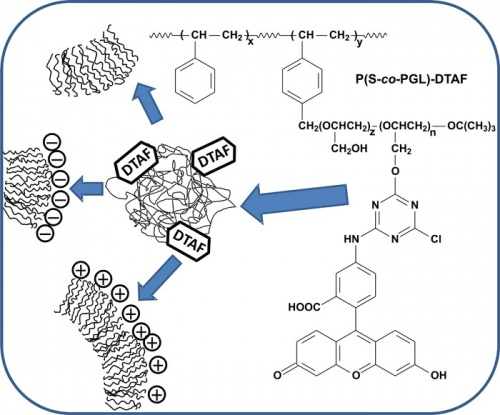
The cited paper investigates the interactions of poly(styrene/a-tert-butoxy-w-vinylbenzyl-polyglycidol) copolymers containing DTAF labels [P(S-co-PGL)-DTAF] with micelles of various surfactants by absorption and fluorescence spectroscopy. This research contains a part of the extensive studies on synthesis, characterization and biomedical applications of poly(styrene/a-tert-butoxy-w-vinylbenzyl-polyglycidol) P(S-co-PGL) microspheres. The investigated poly(styrene/a-tert-butoxy-w-vinylbenzyl-polyglycidol) water soluble copolymers resemble the P(S-co-PGL) particles interfacial layer composed from polystyrene and polyglycidol segments which serve as a model of device with hydrophilic-hydrophobic properties. The used surfactant micelles mimic the biological interfacial layers containing charged and/or inert entities. The polyglycidol is a highly hydrophilic polymer and its structure is identical to poly(ethylene oxide) chain with one exception – it contains one methylol group in each repeating unit. In particular diagnostic applications of microspheres, the hydroxyl groups of polyglycidol chains in the surface layer are used for well controlled covalent binding of biomolecules. Moreover, the surface of the P(S-co-PGL) particles involved in medical tests is in direct contact with biological material (physiological liquids, tissues or cells). Surfactant micelles are the simplest model objects that mimic the biological counterparts. The attached Figure shows the structure of labeled copolymer, its random coil in water and partial sections of nonionic, anionic and cationic micelles. The results presented in the paper reveal that P(S-co-PGL)-DTAF behaves differently in various surfactant micelles and opens the way to apply the fluorescent microspheres as a high sensitivity and accuracy means for medical diagnosis.