Advances in Engineering Advances in Engineering features breaking research judged by Advances in Engineering advisory team to be of key importance in the Engineering field. Papers are selected from over 10,000 published each week from most peer reviewed journals.

ACS Nano, 2012, 6 (12), pp 10598–10605
Robert Vácha , Francisco J. Martinez-Veracoechea , Daan Frenkel
National Centre for Biomolecular Research, Faculty of Science and CEITEC—Central European Institute of Technology, Masaryk University, Kamenice 5, 625 00 Brno-Bohunice, Czech Republic, and
Department of Chemistry, University of Cambridge, Lensfield Road, Cambridge, CB2 1EW, United Kingdom
Abstract
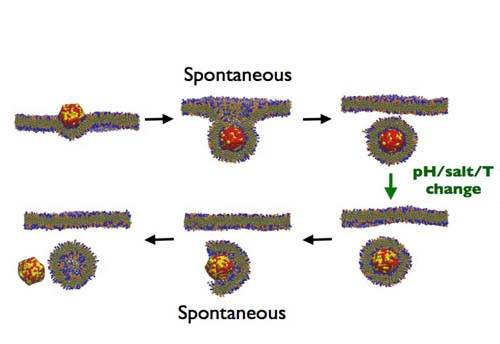
During passive endocytosis, nanosized particles are initially encapsulated by a membrane separating it from the cytosol. Yet, in many applications the nanoparticles need to be in direct contact with the cytosol in order to be active. We report a simulation study that elucidates the physical mechanisms by which such nanoparticles can shed their bilayer coating. We find that nanoparticle release can be readily achieved by a pH-induced lowering of the attraction between nanoparticle and membrane only if the nanoparticle is either very small or nonspherical. Interestingly, we find that in the case of large spherical nanoparticles, the reduction of attraction needs to be accompanied by exerting an additional tension on the membrane (e.g., via nanoparticle expansion) to achieve release. We expect these findings will contribute to the rational design of drug delivery strategies via nanoparticles.
Copyright © 2012 American Chemical Societ
Additional Information
Control of cellular uptake of nanoparticles is a crucial step in drug delivery and nanomedicine. However, the conditions and nanoparticle properties under which passive endocytosis (non ATP-driven) occurs are not well understood. Using Molecular Dynamics simulations with a coarse grained model, we
investigated the necessary conditions for passive uptake and subsequent cytosol escape of the ligand-coated nanoparticles, as a function of size, shape, overage, and receptor-binding strength. Our pioneering simulations showed the spontaneous uptake and escape process across a zero-tension, receptor rich, phospholipid membrane, which was designed to mimic cancer cell membranes with over-expressed receptors.[1,2] In qualitative agreement with Helfrich’s elastic theory, we have found that larger spherical particles undergo endocytosis easier than smaller ones due to a more favorable compromise between
bending rigidity and surface adhesive energy. Moreover, our simulations and elastic analysis suggest that the prolate shape of spherocylinders can lead to more efficient delivery than spheres of the same diameter as both shapes seems to have the same kinetic barrier for uptake across a lipid membrane but the spherocylinders have a larger volume. In addition, we observed that the sharp edges on nanoparticles can hinder the uptake process.
[1] Our simulations showed that the cytosol escape of the uptaken nanoparticles can occur pontaneously if the strength of attraction between nanoparticle ligands and the membrane receptors is lowered sufficiently, as could be caused by changes of the surrounding environment (changes in pH, salt, etc.). In addition, a significant thermodynamic driving force is needed for spontaneous escape to occur within the time scale of our simulation (~hundreds of s). Such driving force can be provided by deformation of the membrane or nanoparticle from its equilibrium state. One way of inducing this deformation is by means of the internal pressure administered by the nanoparticle expansion in the late endosome or by the nanoparticle compression during the initial phase of the uptake process. A econd example way to create a deformation is via the elongated shape of the anoparticle, which causes the encapsulating membrane to be far from the spherical shape of a free vesicle membrane.
[2] The obtained insight on the design principles for optimal particle shape and deformability should be helpful in the rational design and improvement of drug delivery nanocarriers.
1. Vácha, R.; Martinez-Veracoechea, F.J.; Frenkel, D.: Receptor-Mediated Endocytosis of Nanoparticles of Various Shapes. Nano Letters, 2011, 11 (12), 5391– 5395
2. Vácha, R.; Martinez-Veracoechea, F.J.; Frenkel, D.: Intracellular Release of Endocytosed Nanoparticles Upon a Change of Ligand-Receptor nteraction. ACS Naono, 2012, in press,