Advances in Engineering Advances in Engineering features breaking research judged by Advances in Engineering advisory team to be of key importance in the Engineering field. Papers are selected from over 10,000 published each week from most peer reviewed journals.

Sensors and Actuators A: Physical, Volume 197, 1 August 2013, Pages 53-61.
Liang Guo He, Qi Zhang, Cheng Liang Pan, Bin Ju, Zhi Hua Feng.
Department of Precision Machinery and Precision Instrumentation, University of Science and Technology of China, Hefei, Anhui, 230026, China
Abstract
A novel working principle for piezoelectric motors aimed at high force, speed, and efficiency, as well as long service life is proposed in this paper. The principle is based on the synchronized switching control of harmonic vibration, which is derived from a classical electronic device called silicon controlled rectifier. Unlike the sliding friction coupling mechanism of ultrasonic motors and the quasi-static operation strategies of inchworm and impact motors, the new motor overcomes certain critical disadvantages of traditional piezoelectric motors. A linear piezoelectric motor was designed, fabricated and tested. The prototype reached a maximum speed of 8.2 mm/s with a load of 0.5 N, and its maximum load capacity reached up to 5 N. The motor achieved a net efficiency of 18.5% with a load of 2 N.
Additional Information
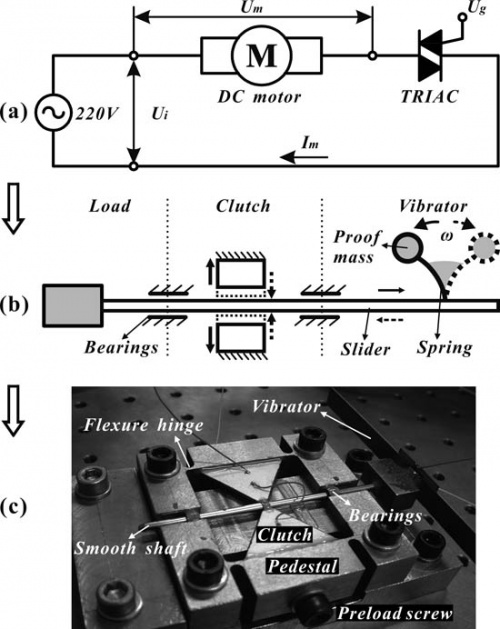
With analogical expectation from the DC motor, corresponding the electrical parameters to the mechanical parameters, a similar controllable transformation in mechanical systems for piezoelectric motor is proposed in the Fig (b). The motor primarily comprises a vibrator, a clutch, and a slider with load supported by bearings. The vibrator, clutch, and slider are respectively analogical to the alternating voltage source, TRIAC, and DC motor in Fig. (a). The vibrator generates a harmonic vibration to actuate the slider, while the clutch clamps or releases the slider periodically. By adjusting the phase between the vibrator and clutch and the duty cycle of the clutch, the speed and direction of the motor can be controlled easily.
A prototype piezoelectric motor was designed and fabricated as shown in Fig. (c). The step size was approximately 5 um, the maximum velocity was 8.2 mm/s, the maximum load capacity was 5 N, and the total efficiency was 18.5%. The motor presents several advantages. First, the power loss of the vibrator and clutch could be very low compared with other coupling mechanisms using sliding friction force directly. Meanwhile, the service life can also be significantly improved in theory as a result of the absence of heat and wear generated from impact and sliding friction. Second, the motor can be used for precise position control because of its small and adjustable step. Finally, the speed can be adjusted over a large range by the step value and practical working cycles.
(a) Control circuit of DC motor, (b) mechanical control system and (c) Photograph.