Advances in Engineering Advances in Engineering features breaking research judged by Advances in Engineering advisory team to be of key importance in the Engineering field. Papers are selected from over 10,000 published each week from most peer reviewed journals.

Optics Express, Vol. 21, Issue S4, pp. A687-A694 (2013).
Chun-Feng Lai, Chung-Chieh Chang, Ming-Jye Wang, and Mau-Kuen Wu.
Department of Photonics, Feng Chia University, 100, Wenhwa Road, Seatwen, Taichung 40724, Taiwan and
Institute of Physics, Academia Sinica, Nankang, Taipei 11529, Taiwan.
Abstract
This study exhibited the correlated color temperature (CCT)- and color-rendering index (CRI)-tuning behavior of light emission from white light-emitting diodes (WLEDs) using three-dimensional non-close-packed (3D NCP) colloidal photonic crystals (CPhCs). The CCT of approximately 5300 K (characteristic of cold WLEDs) of white light propagated through the NCP CPhCs dropped to 3000 K (characteristic of warm WLEDs) because of the photonic stop-bands based on the photonic band structures of NCP CPhCs. This study successfully developed a novel technique that introduces lower-cost CCT- and CRI-tuning cold WLEDs with a CRI of over 90 that of warm WLEDs by using 3D NCP CPhCs.
© 2013 OSA
Additional Information:
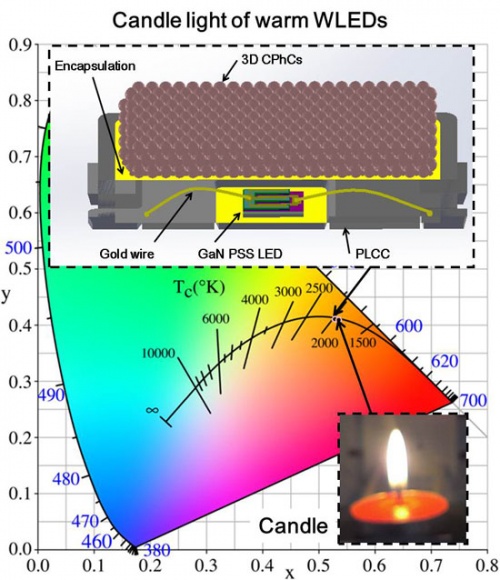
This novel technique also presents the light-spectrum modification of warm white-light-emitting diodes (w-WLEDs) with 3D colloidal photonic crystals (3D CPhCs) to mimic candlelight. The w-WLEDs with 3D CPhCs produce a low correlated color temperature (CCT) of 1963 K, a high color-rendering index (CRI) of 85, and a luminous flux of 22.8 lm (four times that of a candle). This technique decreased the w-WLED CCT of approximately 2700 to 1963 K (similar to the CCT of candlelight) without increasing the concentration of green, yellow, and red phosphor. This novel light source does not involve or produce mercury, ultraviolet light, flickering, flame burning, or carbon blacking and produces at least four times more luminous flux than do traditional candles. Summary, this novel technique applied to w-WLEDs to produce candlelight decreases costs and provides more options for designing safer light fixtures. (See Opt. Letters, vol. 38, pp. 3612-3615, 2013.)