Advances in Engineering Advances in Engineering features breaking research judged by Advances in Engineering advisory team to be of key importance in the Engineering field. Papers are selected from over 10,000 published each week from most peer reviewed journals.

Journal of Electronic Testing. October 2013, Volume 29, Issue 5, pp 697-714.
*Gürkan Uygur, Sebastian M. Sattler.
* Chair of Reliable Circuits and Systems, University of Erlangen-Nuremberg, 91052, Erlangen, Germany.
Abstract
In contrast to combinational logic and master clocked sequential logical, asynchronous feedback circuits are partially defined due to analogous meta-stabilities. We present a novel formalism to exactly explore this digitally assisted analog phenomenon in order to build up a representative test bench that is able to enforce race constraints (meta-stable behavior) for non-deterministics, instabilities as well as for oscillations in feedback structures. Further, we introduce our definitions for consistently modeling under state transition graphs, we provide all entities for modeling asynchronous feedback structures and state our proposed methodology with an exemplary asynchronous circuitry. The given example is explained at a high level of abstraction, all data for revision is provided, too. The approach seems to be capable to test for meta-stabilities, analog behavior in feedback digital structures.
Additional Information:
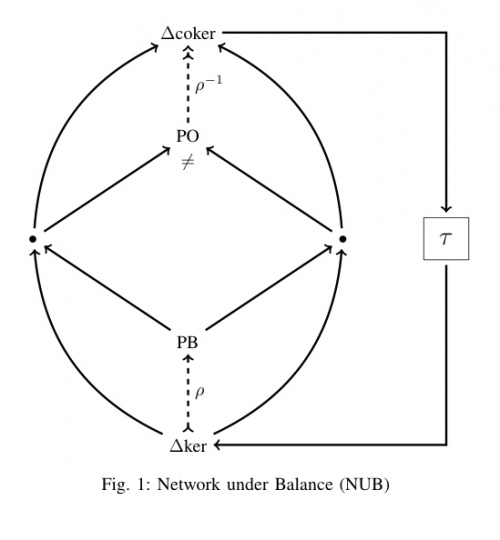
We propose a theoretical framework for the associative composition of functionally stable circuits and systems. It is totally closed under inversion and decomposition and an essential property inherently found in the category of Sets. It can be applied to many applications embedded in asynchronous environment, e. g. asynchronous handshaking, consistently de-composition and composition of information, optimization of feedback throughput in parallel, conflict-free and maximum possible flow of information specified and controlled by any collection of free bases. Therefore, our approach is based on the limit diagram of the theory of categories which is a non-commutative data flow channel (morphism) diagram. Further, we use the category of Partitions with the set Σ of digitally encoded information being partitioned onto b blocks. The technique of encoded morphisms and multi-sets does an upgrade of the limit diagram into a commutative one, such that the maximum possible and conflict-free composition becomes induced and closed under inversion. It is the difference kernel (Δker) which represents all pull-back information (PB), and the difference cokernel (Δcoker), which represents all push-out information (PO). In other words, any element of Δker represents the old pull-back (encoded) information and any element of Δcoker represents the new push-out (encoded) information given in the network under balance (NUB) in Fig.1. The given network can now be interpreted as an asynchronous feed-back, functionally stable automaton. The synchronization point (τ) required for combinational analysis therefore is the state information Δcoker = Δker. As the composition (ρ − 1) is invertible, it can be exhaustively used for issues of test and diagnosis based on a correct-by-construction paradigm.