Advances in Engineering Advances in Engineering features breaking research judged by Advances in Engineering advisory team to be of key importance in the Engineering field. Papers are selected from over 10,000 published each week from most peer reviewed journals.

Applied Mathematical Modelling, Volume 37, Issue 3, 2013, Pages 876–887.
Sergey Utyuzhnikov.
School of Mechanical Aerospace and Civil Engineering, University of Manchester, Manchester M13 9PL, UK.
Abstract
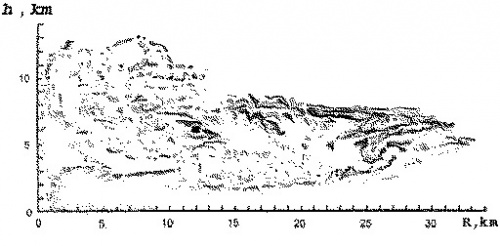
We analyze the lofting of aerosol in the atmosphere over a large scale fire. According to the well-known theory of “nuclear winter”, soot, rising in the atmosphere, may spread in the stratosphere and screen sun rays, which may in turn result in long-term catastrophic consequences for the climate. The height reached by the soot is critical for the climate modeling because long-term global consequences can only be caused by a significant quantity of soot injected into the stratosphere. Most of the studies in the present literature are devoted to long-term modeling. The study of the initial (pyrocumulus) stage of the problem has attracted much less attention with the amount of the soot injected into the mid-latitude stratosphere often being postulated. The amount of smoke that enters the stratosphere is crucial for climate consequences. It is therefore important to predict accurately the active stage of a large-scale fire, which is accompanied by the development of convective columns. The paper is devoted to the analysis of different approaches to the prediction of the altitude of smoke lofting over large scale fires. Some numerical, laboratory and analytical methods are considered. The latter two approaches are based on the theory of similarity. The results obtained by different techniques are compared with each other. Special attention is given to high resolution simulations, which accurately enough resolve gravity waves.
Keywords
Large-scale fire; Plume; Cloud; Smoke; Atmosphere; Nuclear winter
Additional Information from the Author:
The paper is devoted to an experimental, numerical and analytical study of the lofting of aerosol in the atmosphere over a large scale fire. According to the well-known theory of “nuclear winter”, soot, rising in the atmosphere, may spread in the stratosphere and screen sun rays, which may in turn result in long-term catastrophic consequences for the climate. The height reached by the soot is critical for the climate modeling because long-term global consequences can only be caused by a significant quantity of soot injected into the stratosphere. Most of the studies in the present literature are devoted to long-term modeling. The study of the initial (pyrocumulus) stage of the problem has attracted much less attention with the amount of the soot injected into the mid-latitude stratosphere often being postulated. The amount of smoke that enters the stratosphere is crucial for climate consequences. It is therefore important to predict accurately the active stage of a large-scale fire, which is accompanied by the development of convective columns.
The paper presents the analysis of different approaches to the prediction of the altitude of smoke lofting over large scale fires. Some numerical, laboratory and analytical methods are considered for the first time. The latter two approaches are based on the theory of similarity. The results obtained by different techniques are compared with each other. Special attention is given to high resolution simulations, which accurately enough resolve gravity waves.