Advances in Engineering Advances in Engineering features breaking research judged by Advances in Engineering advisory team to be of key importance in the Engineering field. Papers are selected from over 10,000 published each week from most peer reviewed journals.

G. Delaizir, J. Monnier, M. Soulier, R. Grodzki, B. Villeroy, J. Testard, J. Simon, C. Navone, C. Godart
Sensors and Actuators A: Physical, Volume 174, February 2012
Abstract
An original and rapid way to build efficient thermo-generator in one step based on n-type and p-type (Bi,Sb)2 (Te,Se)3nano-materials embedded in a polymer matrix is described. n-type and p-type nano-powders are obtained through a mechanical alloying process leading to particle size of about 50 nm. The flexible thermo-generator is assembled in one step in few minutes by Pulsed Current Electrical Sintering (PECS) also known as Spark Plasma Sintering (SPS) from a stacking of: 1) p-type powder, 2) special design of an electrical insulating polymer matrix (from 8mm to 100mm diameter) and 3) n-type powder. After polishing the two sides of the thermo-generators in order to reveal series of n-type and p-type thermo-elements, electrical connections of these plots are made. Due to the fast sintering treatment, the nanostructure of thermo-elements is conserved. The full thermoelectric characterizations of such thermo-generator have been investigated leading to a generated output voltage of 51mV for 17 thermocouples (ΔT~14°C) [1]. Flexibility of thermo-generator can lead to new types of application (envelop of muffler or nuclear pipe for heat recovery, ambient assisted living wearable biometric sensors, refrigerant bag pack for militaries, etc). These results pave the way to new types of engineering process regarding the fabrication of thermo-generator (flexible or not) which is usually time consuming and small (few cm2). This technology can be easily transferred to all types of thermo-generator working in different ranges of temperature.
[1] – International Patent WO 2012/076809, « Thermo-generator and process for producing thermo-generator », G. Delaizir, J. Monnier, C. Godart, J. Testard, C. Navone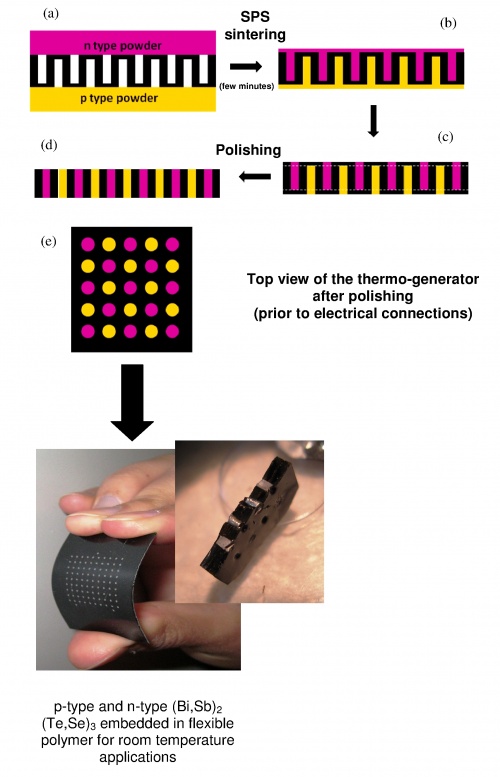
Go to Journal