 Advances in Engineering Advances in Engineering features breaking research judged by Advances in Engineering advisory team to be of key importance in the Engineering field. Papers are selected from over 10,000 published each week from most peer reviewed journals.

Significance Statement
This paper presents important results in the framework of research project supported by SNF (Swiss National Foundation). This has been established through a consortium of institutes and laboratories and devoted to the fabrication of a micro fuel cell. The present work includes some of valuable contributions in industrial applications, physical modeling and numerical techniques:
1- Industrial application: novel engineering results are obtained with a complete design space for thin-film fabrication in different buckling stages. This is supported by experimental validations.
2- Physical model: the energy explanation of the buckling shape (subsection 5.3) as well as the thermodynamic interpretation of the buckling (subsection 5.3.1) represent a new instructive insight on understanding of thin-film buckling.
3- Numerical techniques: Although that Rayleigh-Ritz is a well known method for the representation of buckling patterns, we introduce here, in the context of this method, an instructive way to address the related mathematical analysis. Further, the following tasks are achieved within a comprehensible means using Mathematica without any additional packages:
a- Code implementation supported by numerical and experimental validations.
b- Estimation of the degree of post-buckling stability based on Hessian spectrum.
c- Numerical prediction of second bifurcation (subsection 4.3).
The above mentioned contributions are expected to enhance the usability of this paper and allow readers to reproduce this implementation and then to be exploited in wide range of film-based technologies.
Furthermore, this procedure has paved the way for a further exploitation of this work within coming publications on buckling with imperfection conditions, and further, on the a generic implementation of Ritz method for different film geometries.
Figure Legend
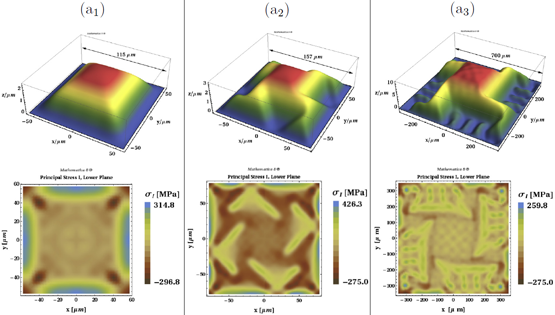
Simulation results for a buckled film of 300 nm thickness under residual compressive stress equals -275 Mpa for three test cases with side lengths 115, 157 and 700 mm. (ai), i=1,2 and 3: the buckling shape and the principal stresses on the lower surface the film in primary and secondary buckling modes.
Journal Reference
Yasser Safa, Thomas Hocker. Applied Mathematical Modelling, Volume 39, Issue 2, 2015, Pages 483-499.
ICP Institute of Computational Physics, ZHAW Zurich University of Applied Sciences, Technikumstrasse 9, CH-8401 Winterthur, Switzerland.
Abstract
The buckling of an elastic thin film is studied in the light of an energy minimization method. Specifically, a comprehensive treatment of the Rayleigh–Ritz method is presented. Detailed mechanical modelling, analytical and numerical derivation of stability criteria, physical interpretation of buckling shapes, numerical code implementation, and experimental validations of selected simulations are addressed.
The thin film deflection is prescribed as a superposition of buckle functions to provide displacement field parameterizations involving trigonometric functions. An energy minimization procedure is applied to calculate the unknown coefficients to predict the buckling shape and amplitude. Critical buckling values representing the thresholds for instability transitions in the system are calculated from the eigenvalues of the Hessian of the potential energy.
Comparison between simulation results and experimental measurements show the great potential of this method to predict thin film buckling. The validated model is exploited by derivation of a new design space for thin film fabrication where the post-buckling mechanics is controlled.
Go To Applied Mathematical Modelling