Advances in Engineering Advances in Engineering features breaking research judged by Advances in Engineering advisory team to be of key importance in the Engineering field. Papers are selected from over 10,000 published each week from most peer reviewed journals.

Umberto Iemma
Journal of Sound and Vibration, Volume 331, Issue 21, October 2012
Abstract
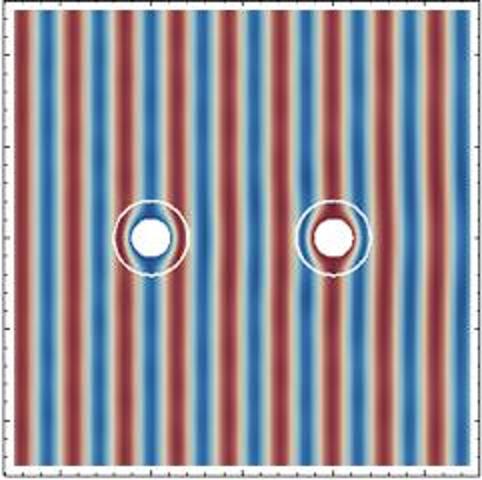
The paper presents an original boundary integral equation (BIE) formulation for the analysis of the acoustic cloaking of a scatterer. The advantage of such an approach is the lower computational burden, especially when the analysis of a large portion of the hosting domain is required. The partial differential equation governing the propagation inside the cloak is recast in the form of non-homogeneous wave equation, with field sources depending on the mechanical properties of the cloak. The boundary integral formulation is derived using the standard procedure. The boundary element method (BEM) is used to derive the matrix transfer function of the cloak. The latter is applied to the incident field at the cloak’s outer boundary to obtain the total field at arbitrary locations in the host. The formulation is applied to the simple case of a radially symmetric cloak embedding a circular obstacle. Numerical results are presented for sound-hard and sound-soft obstacles, including a study of the cloaking efficiency as a function of the frequency.
Additional information:
The paper presents an innovative approach to the modeling of the acoustic Inertial Cloaking (IC) of a scattering obstacle. The equation governing the propagation inside the meta-material constituting the masking mantle is recast into an integral form. The effect of the unconventional mechanical properties of the meta-material are taken into account in form of distributed field sources. The resulting integral equation is coupled with the standard boundary integral equation valid within the hosting medium, by means of the field continuity conditions through the outer boundary of the cloak.
The integral formulation is numerically solved using the Boundary Element Method (BEM), suitably extended to cope with the unconventional nature of the propagation inside the cloak. The formulation is applied to the classic Cummer-Shurig problem in order to validate the methodology on a widely assessed problem for which an exhaustive literature is available. The results of an extensive campaign of numerical tests are presented for a wide range of frequencies and for different acoustic properties of the masked object. The results reveal the capability of the method to correctly predict the masking effect of the Cummer-Shurig inertial cloak. A careful analysis of the asymptotic behavior of the cloaking mantle at high frequencies is included. The method described in the paper is in course of constant development and is currently being extended to the cloaking of moving three-dimensional objects. Alternative approaches to avoid the well-known “infinite-mass” problem typical of the IC approach are under development. \
Go to Journal