Advances in Engineering Advances in Engineering features breaking research judged by Advances in Engineering advisory team to be of key importance in the Engineering field. Papers are selected from over 10,000 published each week from most peer reviewed journals.

Appl. Phys. Lett. 102, 111109 (2013).
Hao-Ting Huang, Chen-Yu Huang, Tzong-Rong Ger, Zung-Hang Wei.
Department of Power Mechanical Engineering, National Tsing Hua University, Hsinchu 300, Taiwan.
Abstract
We verified that the heat dissipation of surface plasmon resonance can be measured usingphotothermal deflection method. The maximum value of photothermal deflection corresponded to the occurrence of surface plasmon resonance. The detection of anti-integrin and integrinbiomolecules that exhibit specific binding was demonstrated using this technique. From our experimental results it shows that the photothermal deflection method can be used to obtain the surface plasmon resonance angles and angle shift.
Additional Information:
We verified that the heat dissipation of surface plasmon resonance can be measured using photothermal deflection method. The maximum value of photothermal deflection corresponded to the occurrence of surface plasmon resonance. The detection of anti-integrin and integrin biomolecules that exhibit specific binding was demonstrated using this technique. From our experimental results it shows that the photothermal deflection method can be used to obtain the surface plasmon resonance angles and angle shift.
Selected recent publications by this group.
- H. T. Huang, T. R. Ger, Y. H. Lin, and Z. H. Wei, “Single cell detection using magnetic zigzag nanowire biosensor,” Lab Chip 13, 3098 (2013).
- T. R. Ger, H. T. Huang, C. Y. Huang, and M. F. Lai, “Single cell detection using 3D magnetic rolled-up structures,” Lab Chip 13, 4225 (2013).
- T. R. Ger, H. T. Huang, W. Y. Chen and M. F. Lai, “Magnetically-controllable zigzag structures as cell microgripper,” Lab Chip 13, 2364-2369 (2013).
- M. F. Lai, C. Y. Chen, C. P. Lee, H. T. Huang, T. R. Ger, and Z. H. Wei, “Cell patterning using micro-structured ferromagnetic thin films,” Appl. Phys. Lett. 96, 183701 (2010).
- H. T. Huang, C. Y. Huang, T. R. Ger, and Z. H. Wei, “Anti-integrin and integrin detection using the heat dissipation of surface plasmon resonance,” Appl. Phys. Lett. 102, 111109 (2013).
- H. T. Huang, C. Y. Chen, and M. F. Lai, “Cells positioning using magnetic domain walls of ferromagnetic zigzag thin film,” J. Appl. Phys. 109, 07B315 (2011).
- H. T. Huang, Y. H. Lin, T. R. Ger, and Z. H. Wei, “Detection of magnetically labeled cells using wavelike permalloy nanowires,” Appl. Phys. Express 6, 037001 (2013).
- C. P. Lee, B. Y. Fang, and Z. H. Wei, “Influence of electrolytes on contact angles of droplets under electric field,” Analyst 138, 2372 (2013).
- Tzong-Rong Ger, Chen-Chi Huang, Hao-Ting Huang, and Zung-Hang Wei, “Investigation of the magnetization process in a three-dimensional curled up structure,” J. Appl. Phys., vol. 109, p. 07E534, 2011.
- C. P. Lee, H. Y. Tsai, and M. F. Lai, “Rotary transportation of magnetic nanoparticle chains on magnetic thin film array,” Appl. Phys. Lett. 100, 264102 (2012).
- T. R. Ger, Y. R. Xu, H. T. Huang, and Z. H. Wei, “A permalloy zigzag structure based magnetic bio-sensor,” J. Appl. Phys. 111, 07E506 (2012).
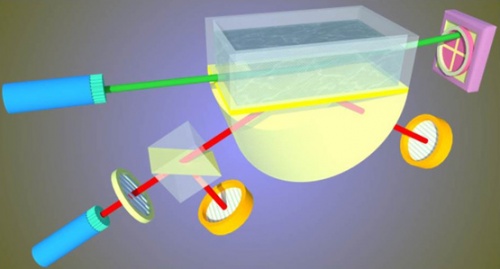
FIG. 1. Experimental setup of SPR system combined with photothermal deflection system.