Advances in Engineering Advances in Engineering features breaking research judged by Advances in Engineering advisory team to be of key importance in the Engineering field. Papers are selected from over 10,000 published each week from most peer reviewed journals.

Biosystems Engineering, Volume 112, Issue 3, July 2012, Pages 171–180.
Marco Bietresato, Dario Friso, Luigi Sartori
University of Padova, Department of Land, Environment, Agriculture and Forestry, T.e.S.A.F., Section of Mechanization, Construction and Plant Engineering, viale dell’Università 16, I-35020 Legnaro (PD), Italy
Abstract
A theoretical model that could be useful for investigating the performance of ground vehicles using acceleration tests was developed. The model takes into account all of the forces acting on a moving vehicle to give a description of its kinematics: the rolling friction of the propulsion devices, their slip on the soil, aerodynamic resistance, road slope and traction developed by the engine. In the methodology of applying the model, the experimental data collected during acceleration tests on a flat and sloping road from a standing start to reach a given distance or a stated speed are used to determine the average efficiency of the transmission of three tractors with different equipment (a mechanical full-powershift drive and two different hydro-mechanical continuously-variable ratio transmissions – CVT). The same model was also used to predict tractor performance during other acceleration tests. The results of the CVT tests suggest that there probably is an influence of the transmission architecture that takes precedence over the general type of the transmission.
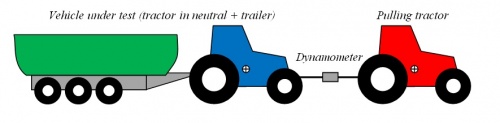
Figure legend: Test configuration used to estimate the rolling resistance.