Advances in Engineering Advances in Engineering features breaking research judged by Advances in Engineering advisory team to be of key importance in the Engineering field. Papers are selected from over 10,000 published each week from most peer reviewed journals.

Quantum Information Processing, January 2014, Volume 13, Issue 1, pp 5-20.
GuoDong Kang, QingPing Zhou, MaoFa Fang, YanLiang Zhang.
Key Laboratory of Software Engineering of Ministry of Education, School of Software and Service Outsourcing, JiShou University, Zhangjiajie, 427000, China and
Key Laboratory of Low-Dimensional Quantum Structures and Quantum Control of Ministry of Education, Department of Physics, Hunan Normal University, Changsha, 410081, China.
Abstract
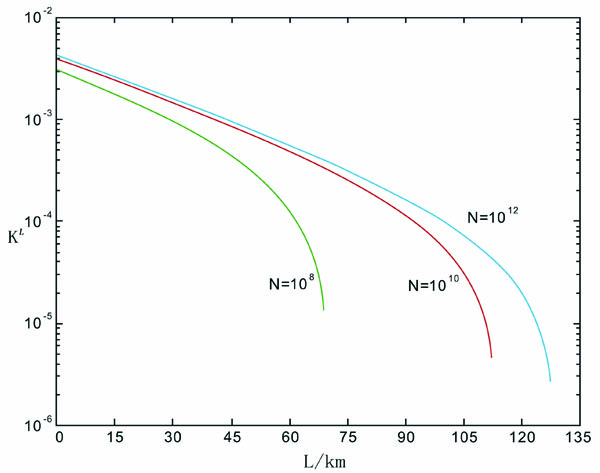
In this paper, we present an asymmetric “4+2” protocol for quantum key distribution with finite photon pulses. The main work of this paper focuses on the composable security proof for this protocol in a finite-key scenario. Based on the essence security basis of the original “4+2” protocol proposed by Huttner et al. (Phys Rev A 51(3):1863–1869, 1995), we first develop the squashing model for this protocol with the quantum non-demolition measure theory. From this model, against the collective photon-number-splitting attack, we then provide the security proof (formulas of finite-key security bounds) for this protocol. The expected performance of this protocol are also evaluated on a priori reasonable expected values of parameters. Our work shows that the performance we derived is the lower one and it can cover long distances in the lossy channel.
Significance Statement:
This paper advances our understanding and knowledge in quantum mechanics especially in secure communication applications. It is a further improvement of Huttner protocols toward developing secure communication against the most powerful collective PNS attacks and it generalized the “4+2”; idea to fnite cases with today’s state-of-the-art. The simulation result shows that the lower performance of it is powerful to cover long distances (over 100km) in the lossy channel.
This work has been supported by National Natural Science Foundation of China under Grant Nos.(11464015, 11264013). the Nature Science foundation of Hunan province under Grant No.14JJ6035, the Education Ministry of Hunan province Nos.(11A096, 14B147).
Figure legend: Lower performance of this protocol in finite cases. As a function of the transmission distance L, with some experiment parametes for QKD,we numerically simulated the optimal bounds of the security K in three cases: the green curve, the red curve and the blue curve respectively.