Advances in Engineering Advances in Engineering features breaking research judged by Advances in Engineering advisory team to be of key importance in the Engineering field. Papers are selected from over 10,000 published each week from most peer reviewed journals.

Kai Huebner
Robotics and Autonomous Systems, Volume 60, Issue 3, March 2012
Abstract
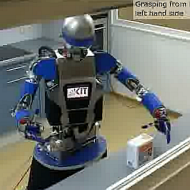
In this paper, we conclude our work on shape approximation by box primitives for the goal of simple and efficient grasping. As a main product of our research, we present the BADGr toolbox for Box-based Approximation, Decomposition and Grasping of objects. The contributions of the work presented here are twofold: in terms of shape approximation, we provide an algorithm for creating a 3D box primitive representation to identify object parts from 3D point clouds. We motivate and evaluate this choice particularly towards the task of grasping. As a contribution in the field of grasping, we further provide a grasp hypothesis generation framework that utilizes the chosen box presentation in a flexible manner.
Additional information:
In this work, we conclude our work on shape approximation by box primitives for the goal of simple and efficient robot grasping. As a main product of our research, we present the BADGr toolbox for Box-based Approximation, Decomposition and Grasping of objects. The contributions of the work presented here are twofold: in terms of shape approximation, we provide an algorithm for creating a 3D box primitive representation to identify object parts from 3D point clouds. We motivate and evaluate this choice particularly towards the task of grasping. As a contribution in the field of grasping, we further provide a grasp hypothesis generation framework that utilizes the chosen box presentation in a flexible manner.
In the paper, we also present architecture and capabilities of the the Box-based Approximation, Decomposition and Grasping (BADGr) software framework, which is publicly available under the BSD license. The challenges we approach in this software are: (1) the transformation of arbitrary 3D point data into meaningful, part-based representations of 3D boxes, (2) the planning of intuitive, part-based pre-grasps from that representation, and (3) the extraction of important task-relevant features to create a database for various learning techniques.
While the BADGr toolbox finds application in to a number of scenarios related to grasping, it also reveals interesting connections to neighboring research areas such as graphical modeling, 3D shape segmentation, 3D shape approximation, machine vision, or machine learning.
Project homepage: http://www.csc.kth.se/~khubner/badgr
Source repository: http://sourceforge.net/projects/badgr/
Go to Journal