Advances in Engineering Advances in Engineering features breaking research judged by Advances in Engineering advisory team to be of key importance in the Engineering field. Papers are selected from over 10,000 published each week from most peer reviewed journals.

Electrochemistry Communications, Volume 47, October 2014, Pages 63–66.
Stefano Cinti1,2, Fabiana Arduini1,2, Giada Vellucci1,2, Ilaria Cacciotti3, Francesca Nanni4, Danila Moscone1,2
- Dipartimento di Scienze e Tecnologie Chimiche, Università di Roma Tor Vergata, Via della Ricerca Scientifica, 00133 Rome, Italy and
- Consorzio Interuniversitario Biostrutture e Biosistemi “INBB”, Viale Medaglie d’Oro, 305, Rome, Italy and
- Università degli Studi di Roma “Niccolò Cusano”, UdR INSTM, Via Don Carlo Gnocchi 3, 00166 Rome, Italy and
- Dipartimento di Ingegneria dell’Impresa, Università di Roma Tor Vergata, UdR INSTM Roma-Tor Vergata, Via del Politecnico 1, 00133 Rome, Italy
Abstract
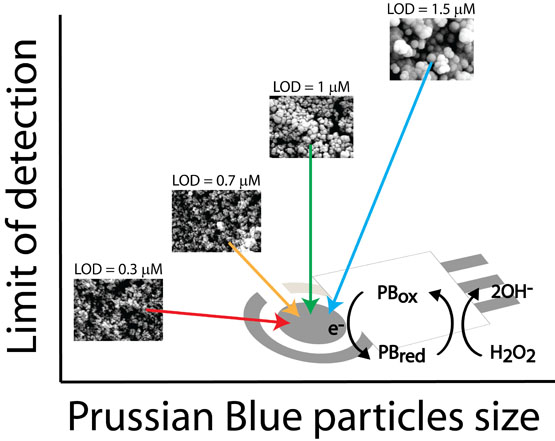
Ferric hexacyanoferrate or Prussian Blue is an inorganic crystal characterized by a zeolite structure and it is also known as an artificial peroxidase, since its reduced form (PBred or Prussian White) is capable to selectively catalyze the reduction of hydrogen peroxide operating at low potential (close to 0 V vs. Ag/AgCl). In this work, by means of different synthetic routes, we are able to tailor Prussian Blue size and consequently to tune its analytical performance as detection limit and sensitivity towards the detection of hydrogen peroxide. The presence of different carbonaceous substrates such as graphite or Carbon Black Nanoparticles influence the processes related to the nucleation and growth of Prussian Blue Nanoparticles yielding on different electrocatalytic properties. This work provides the possibility of fabricating an ad hoc electrochemical sensor depending on the analytical needs, just by controlling the experimental conditions of Prussian Blue synthesis