Advances in Engineering Advances in Engineering features breaking research judged by Advances in Engineering advisory team to be of key importance in the Engineering field. Papers are selected from over 10,000 published each week from most peer reviewed journals.

Significance statement
One of the most significant challenges to the economic operation of seawater reverse osmosis (SWRO) desalination facilities is the control of membrane biofouling. Seawater contains a variety of naturally-occurring organic particles and compounds that control conditioning of the membrane surface and ultimately, the building of a biofilm that inhibits the flux, causes frequent cleaning, and reduces the life expectancy of the membranes.
We have found that the intake type and pretreatment processes can effectively control the concentration of algae, bacteria, organic carbon fractions, and transparent exopolymer particles (TEP) that contribute to biofouling. TEP consists of acidic polysaccharides that are sticky and rapidly attach to the surface of SWRO membranes and facilitate attachment of bacteria. Flow from the sea into subsurface intake systems (wells in this case) removes all of the algae, over half of the total organic carbon (TOC), 74 to 84% of the bacteria, a significant percentage of the TEP, and a high percentage of the biopolymer fraction of NOM, all of which contribute to membrane biofouling. Placement of the intake depth to 9 m below surface compared to the sea surface produced little improvement in organics removal.
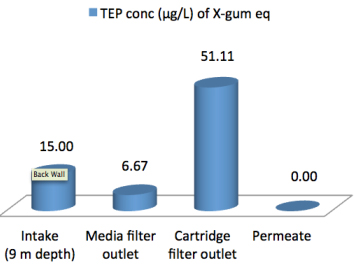
It was demonstrated that after removal of TEP and bacteria using a well intake system or pretreatment, bacterial regrowth can occur within the cartridge filter system. Downstream from the cartridge filter increases in bacteria concentration and increases in TEP concentration were observed with particulate TEP rising 667% in one system.
This research suggests that design of the intake and pretreatment systems reduce the organic compound concentrations and bacteria that cause biofouling, which can reduce the rate of biofilm formation. The reduction in rate of biofilm growth tends to improve operational efficiency of SWRO systems. The issue of bacterial regrowth in cartridge filters suggests that a new type of filter system, which does not allow bacteria regrowth and TEP production, is required to protect the membranes from particulate intrusion or the use of cartridge filters may not be required on some SWRO systems.
Figure Legend
Increase in particulate TEP concentration (ppb) across the cartridge filters at one system.
Journal Reference
Abdullah H. A. Dehwah1, Sheng Li1, Samir Al-Mashharawi1, Harvey Winters2, Thomas M. Missimer3 . Desalination, Volume 360, 2015, Pages 19-27.
[expand title=”Show Affiliations”]1King Abdullah University of Science and Technology, Water Desalination and Reuse Center, Thuwal, 23955-6900, Saudi Arabia
2Fairleigh Dickinson University, Natural Resources, Teaneck, NJ 07666, United States
3Florida Gulf Coast University, U. A. Whitaker College of Engineering, 10501 FGCU Boulevard South, Fort Myers, FL 33965-6565, United States. [/expand]
Abstract
Transparent exopolymer particles (TEP), natural organic matter, and bacterial concentrations in feedwater are important factors that can lead to membrane biofouling in seawater reverse osmosis (SWRO) systems. Two methods for controlling these concentrations in the feedwater prior to pretreatment have been suggested; use of subsurface intake systems or placement of the intake at a greater depth in the sea. These proposed solutions were tested at two SWRO facilities located along the Red Sea of Saudi Arabia. A shallow well intake system was very effective in reducing the algae and bacterial concentrations and somewhat effective in reducing TEP concentrations. An intake placed at a depth of 9 m below the surface was found to have limited impact on improving water quality compared to a surface intake. The algae and bacteria concentration in the feedwater (deep) was lower compared to the surface seawater, but the overall TEP concentration was higher. Bacteria and TEP measurements made in the pretreatment process train in the plant and after the cartridge filters suggest that regrowth of bacteria is occurring within the cartridge filters.