Advances in Engineering Advances in Engineering features breaking research judged by Advances in Engineering advisory team to be of key importance in the Engineering field. Papers are selected from over 10,000 published each week from most peer reviewed journals.

Colloids and Surfaces A: Physicochemical and Engineering Aspects, Available online 7 March 2013.
I. Zelano, Y. Sivry, C. Quantin, A. Gélabert, M. Tharaud, D. Jouvin, E. Montarges-Pelletier, J. Garnier, R. Pichon, S. Nowak, S. Miska, O. Abollino, M.F. Benedetti
Univ. Paris Diderot, Sorbonne Paris Cité, Institut de Physique du Globe de Paris, UMR 7154, CNRS, Paris F-75205, France
Università degli Studi di Torino, Via Pietro Giuria 5, Torino 10125, Italy
UMR 8148 IDES, Univ. Paris Sud-CNRS, Orsay Cedex 91405, France
CNRS, Université de Lorraine, Laboratoire Environnement et Minéralurgie, UMR 7569, Vandœuvre-lès-Nancy F-54500, France
Universidade de Brasilia, IG/GMP-ICC Centro, Brasilia-DF 70919-970, Brazil
Univ. Paris Diderot, Sorbonne Paris Cité, ITODYS, UMR 7086, CNRS, Paris F-75205, France
Abstract
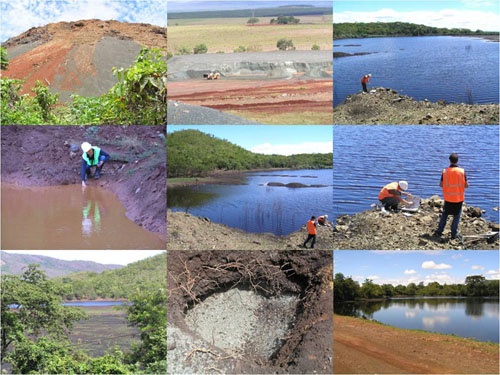
The overall objective of this work was to assess the modification of Ni availability and lability consequently to anthropic activity. Surface waters were collected in two ultramafic complexes (Barro Alto and Niquelândia) from Goías State (Brazil) impacted by mining and metallurgical activities. For the nearly first time, Isotopic Exchange Kinetic technique (IEK) was performed on these natural water samples to quantify the pool of isotopically exchangeable Ni from the suspended particulate matter (SPM) in water, defined here as . The SPM mineralogy was investigated by X-Ray Diffraction (XRD), Scanning and Transmission Electron Microscopy (SEM and TEM). This allowed to establish the link between Ni availability and its solid speciation. Goethite, chlorite, talc and serpentine were identified as the main Ni bearing phases in SPM far from metallurgy (Barro Alto site) while in samples located in the area influenced by metallurgy (Niquelândia) Ni was mainly associated to spherical micrometric particles, related to fly ash produced by the ore combustion. In Niquelândia samples value was found ranging between 2.4 and 565 µg L-1, while in Barro Alto was 62 µg L-1, which corresponds to ENi values of 49,000 and 2350 mg kg-1, in SPM from Niquelândia and Barro Alto, respectively. Moreover, IEK experiments highlighted differences in kinetic of Ni exchanges: the maximum value was reached after only 19 hours of interaction in Barro Alto sample, while in Niquelândia ones hardly reached 70 to 95% of the maximum after the same period of time. On the one hand, both the low proportion and high velocity of Ni exchanges observed in Barro Alto sample may be attributed to surface complexation on talc, serpentine, chlorite and goethite. On the other hand, both the higher proportion of exchangeable stock and slower isotopic exchanges should be mostly attributed in Niquelândia samples to Ni interaction with the anthropogenic spherical and porous particles of Fe-Mg-Si-Al composition, related to FBA released by metallurgic activity.