Advances in Engineering Advances in Engineering features breaking research judged by Advances in Engineering advisory team to be of key importance in the Engineering field. Papers are selected from over 10,000 published each week from most peer reviewed journals.

Chemical Engineering Science, Volume 90, 7 March 2013, Pages 10-16.
Paul Michelis, John Vlachopoulos.
Institute of Mechanics of Materials and Geostructures S.A., IMMG SA, 22 Askiton Street, 15236 Penteli, Greece.
McMaster University, Department of Chemical Engineering, Hamilton, Ontario, Canada L8S 4L7.
Abstract
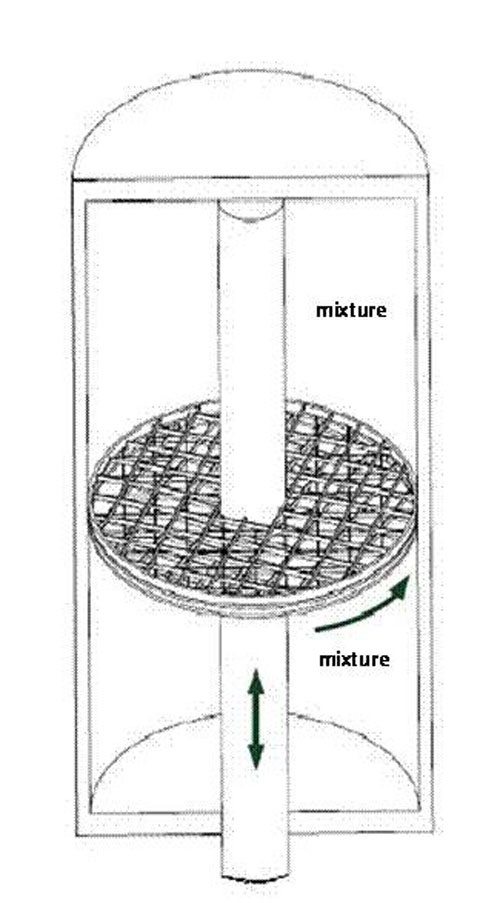
Disentanglement, dispersion of CNTs without attrition and efficient interfacial interaction with polymer chains are a major challenge in developing CNT/polymer composites. In the present device the mixture of highly viscous polyphosphoric acid (PPA) and entangled MWCNTs fills a hollow cylinder where a perforated piston, encasing micro-grids, is axially translating, oscillating and simultaneously rotating. This generates an extensional-shear-spiralling flow, magnified in the entrance/exit zone of the grid micro-openings, the smallest having diameter of 40 um. The reciprocating action forces the agglomerates to cross the grid many times, while the oscillation reduces effectively the clogging of the grid. Flow micro-splitting and recombination, across millions of micro-openings in a time dependent regime, facilitated erosion and collision mechanisms to prevail, leading to a gradual CNT deagglomeration–dispersion without CNT attrition. The resulting high multi-directional-rotational flow generated the conditions for efficient functionalisation.
Additional Information:
A highly efficient industrial micro-structured mixer – reactor was developed, based on the strong extensional flow generated in the micro- orifice. A unit of micro-grids (simulating orifice flow) of varying diameter are encased in a piston, which translates (and oscilates for de-clogging agglomerates) and rotates within a cylindrical vessel filled with the mixture.