Advances in Engineering Advances in Engineering features breaking research judged by Advances in Engineering advisory team to be of key importance in the Engineering field. Papers are selected from over 10,000 published each week from most peer reviewed journals.

Journal of Solid State Electrochemistry, 2014, Volume 18, Issue 4, pp 965-973. Marco Giorgetti, Domenica Tonelli, Mario Berrettoni, Giuliana Aquilanti, Marco Minicucci.
- Department of Industrial Chemistry “Toso Montanari”, University of Bologna, INSTM, UdR Bologna, Viale Risorgimento 4, 40136, Bologna, Italy
- Department of Industrial Chemistry “Toso Montanari,” UOs (unità operativa di sede) Campus di RIMINI, University of Bologna, INSTM, Bologna, Italy
- Sincrotrone Trieste S.C.p.A, S.S. 14 Km 163.5, 34149 Basovizza, Trieste, Italy
- CNISM, School of Science and Technology, Physics Division, University of Camerino, Via Madonna delle Carceri, 62032, Camerino, (MC), Italy
Abstract
X-ray absorption spectroscopy (XAS) has been used to monitor the local geometry of Fe and Cu sites of copper hexacyanoferrates (CuHCF)-modified electrodes which find application in the electrochemical detection of hydrogen peroxide. The XAS approach has permitted to check the nature of the Cu and Fe sites and to investigate their local structure around about 500 pm from the metal centres. The measurements have been done on electrodes prior and after the addition of known quantities of hydrogen peroxide at two different concentration ranges, following a protocol consisting of H2O2 addition, applied potential, and rest period. For the CuHCF-modified electrode, this protocol leads to the increasing conversion to an already present “inactive” component, which limits the usability of the sensor; whereas the electrode modified with the Cu2+-loaded CuHCF displays a better resistance to this unavoidable process. In particular, the formation of the “inactive” component takes place more slowly, confirming the capability, at molecular scale, of such Cu-enriched CuHCF used as electrode modifier to detect more efficiently hydrogen peroxide, as recently demonstrated in our previous paper.
Significance Statement:
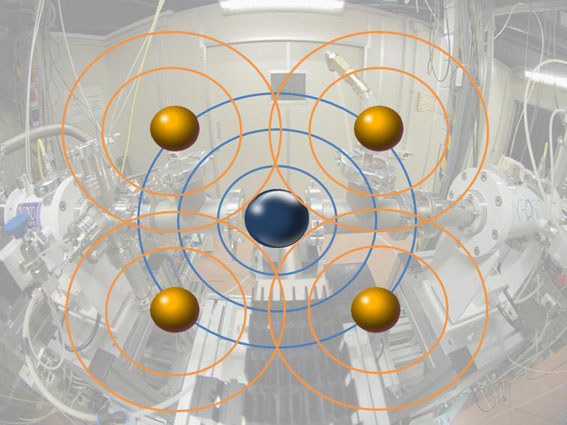
The selectivity of the XAS probe for the atomic species has permitted to check the nature of the Cu and Fe sites during the electrochemical detection of hydrogen peroxide, and to investigate their local structure around about 500 pm from the metal centres. The picture displays the EXAFS event.