Advances in Engineering Advances in Engineering features breaking research judged by Advances in Engineering advisory team to be of key importance in the Engineering field. Papers are selected from over 10,000 published each week from most peer reviewed journals.

SIGNIFICANCE STATEMENT
The HTTR was built at the Oarai Research and Development Center of the JAEA, and is the first HTGR in Japan. The reactor consists of the core and internal components, which are contained in the RPV of height 13,200 mm and diameter 5,500 mm. The core comprises fuel assemblies, CR guide blocks, and replaceable and permanent reflector blocks.
The applicability of the use of muons for in-reactor inspection was evaluated by an inner reactor observation test conducted on the High Temperature Engineering Test Reactor (HTTR) using existing muon telescopes.
The muon detector of the apparatus used for the test consisted of two plastic scintillators, two photo-multipliers, two discriminators, a coincidence circuit, and a counter. The entry of a muon into the scintillator causes light emission, and the light is then converted into an electrical signal, which is multiplied by the photo-multiplier. The discriminator is used to remove the environmental gamma rays.
The employed telescope uses the coincidence method to selectively detect a muon coming from the observation direction. The method counts the muons passing the two scintillators simultaneously, and the extension of the line that connects the two scintillators constitutes the measurement direction.
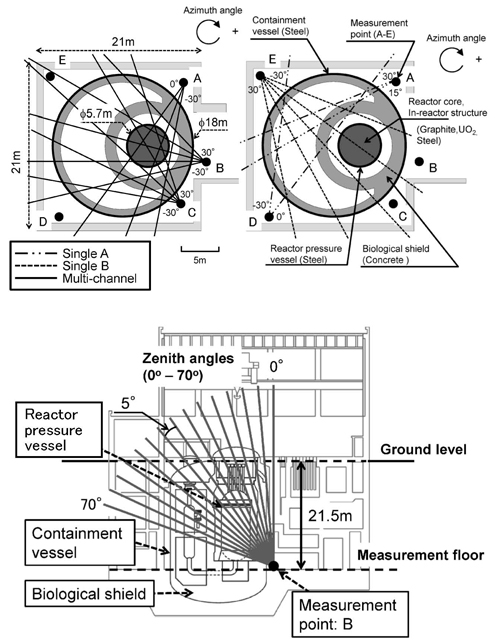
A single-channel-type telescope has the basic configuration of a muon telescope and uses the coincidence method. A multichannel-type telescope is capable of simultaneous measurements in five directions using one main spherical detector and five sub-detectors. The sub-detectors were arranged at intervals of 15°.
The applicability of the nondestructive observation method in which muons are used for in-reactor inspection was evaluated by an observation test conducted on an HTTR using existing muon telescopes that utilize the coincidence method. The measured coincidences of the muons were found to vary with the structure of the HTTR. The main structures were detected based on the distribution of the surface densities calculated from the measured coincidences. This suggests that the nondestructive observation method using muons can be applied to the observation of the inner reactor of a Nuclear Power Plant (NPP) from outside the Reactor Pressure Vessel (RPV) and Containment Vessel (CV).
FIGURE LEGENDS: Measurement points and azimuth angles for single-channel and multichannel telescopes, zenith angles of measurement at point B, and results of surface density at each measurement point.

FEATURED AUTHORS INFORMATION
In 1997, Dr. Takamatsu began doctoral studies in cryogenic engineering of Helium at Kyusyu University in Japan. His dissertation was completed in 2000, and the Ph.D. After that, he joined at the high temperature engineering test reactor (HTTR) built by Japan Atomic Energy Agency (JAEA).
He is a Nuclear Engineer and has experiences with operation and maintenance for 4 years, as well as reactor kinetics, reactor dynamics, reactor instrumentation and thermal-hydraulics for 12 years at the HTTR.
Journal Reference
Kuniyoshi Takamatsu1, Hiroaki Takegami1, Chikara Ito2, Keiichi Suzuki3, Hiroshi Ohnuma3, Ryutaro Hino1, Tadahiko Okumura4, 5. Annals of Nuclear Energy, Volume 78, 2015, Pages 166–175.
[expand title=”Show Affiliations”]1 Nuclear Hydrogen and Heat Application Research Center, Japan Atomic Energy Agency, 4002 Narita-cho, Oarai-machi, Higashiibarakigun, Ibaraki 311-1393, Japan
2 O-arai Research and Development Center, Japan Atomic Energy Agency, 4002 Narita-cho, Oarai-machi, Higashiibarakigun, Ibaraki 311-1393, Japan
3 Kawasaki Geological Engineering Co., Ltd., 2-11-15, Mita, Minato-ku, Tokyo 108-8337, Japan
4 Engineering Advancement Association of Japan, 3-8-19, Tranomon, Minato-ku, Tokyo 105-0001, Japan
5 Energy Society of Japan, 2-3-7, Shimbashi, Minato-ku, Tokyo 105-0004, Japan
[/expand]One of the critical problems that have arisen from the accident at TEPCO’s Fukushima Daiichi nuclear power plant is the removal of fuel debris. For solving this problem, an examination of the internal reactors has been planned to identify the fuel debris. However, the high radiation dose around the reactors has necessitated the development of a remote sensing method that would enable observation of the internal reactors from the outside. In our study, we focused on a nondestructive inspection method by which cosmic-ray muons could be used to observe the internal reactor from outside the reactor pressure vessel (RPV) and containment vessel (CV). We conducted an observation test on the high-temperature engineering test reactor (HTTR) at the Japan Atomic Energy Agency to evaluate the applicability of the method to the internal visualization of a reactor. We also analytically evaluated the resolution of existing muon telescopes to assess their suitability for the HTTR observation, and were able to detect the major structures of the HTTR based on the distribution of the surface densities calculated from the coincidences measured by the telescopes. Our findings suggested that existing muon telescopes could be used for muon observation of the internal reactor from outside the RPV and CV.
Go To Annals of Nuclear Energy