Advances in Engineering Advances in Engineering features breaking research judged by Advances in Engineering advisory team to be of key importance in the Engineering field. Papers are selected from over 10,000 published each week from most peer reviewed journals.

Engineering Structures, Volume 42, September 2012, Pages 387-395
Viktor Gribniak, Gintaris Kaklauskas, Albert Kwok Hung Kwan, Darius Bacinskas, Darius Ulbinas
Department of Strength of Materials, Vilnius Gediminas Technical University, Vilnius, Lithuania
Department of Bridges and Special Structures, Vilnius Gediminas Technical University, Vilnius, Lithuania
Department of Civil Engineering, The University of Hong Kong, Hong Kong
Abstract
One of the most critical points in the theory of steel fibre reinforced concrete (SFRC) is quantifying the residual stresses in tension. Due to concrete interaction with fibres, a cracked section is able to carry a significant portion of tensile stresses, called the residual stresses. Because of a great diversity in the shape and aspect ratio of fibres and, consequently, varying bond characteristics, there are no currently available reliable constitutive models. In present practices, residual stresses needed for strength, deflection and crack width analysis are quantified by means of standard bending tests. However, such tests require relatively sophisticated and expensive equipment based on the displacement-controlled loading. Besides, the test results are highly scattered. This paper investigates an alternative approach for defining the residual stresses. The approach aims at deriving equivalent stress–strain relations of cracked tensile concrete using test moment–curvature relationships of flexural concrete members with ordinary rein forcement and steel fibres. Tests on eight lightly reinforced beams (reinforcement ratio 0.3%) with different contents of steel fibres (0%, 0.5%, 1.0%, and 1.5% by volume) have been carried out. Based on the proposed technique, equivalent stress–strain relations were defined for each of the beams and further used for curvature and crack width analyses.
Additional information
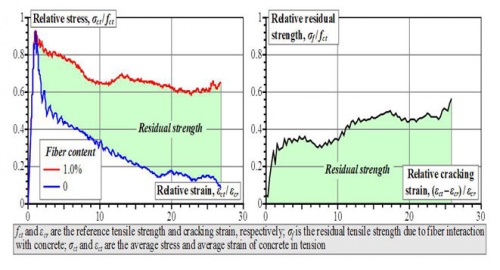
Quantifying the residual tensile strength (stresses) for a cracked section is one of the most critical points in the theory of steel fiber reinforced concrete (SFRC). The paper reports an alternative and novel approach for obtaining residual stresses from beam tests. Unlike the standard techniques based on tests of small bending specimens, the proposed approach uses data of moment-curvature diagrams obtained from tests of beams reinforced with bar reinforcement. Solving the inverse deformation problem when the model parameters are selected in accordance to the given response of a real structure, a stress-strain relationship of steel fiber concrete in tension is derived. As can be seen from the Figure, residual stresses can be quantified as the difference of stresses obtained by the proposed inverse technique for the SFRC and conventional (no fibers) RC elements.
It should be noted that the obtained stresses for the SFRC members at a given strain consist of the stresses due to the tension-stiffening effect and the residual stresses due to fiber interaction with concrete. Accordingly a distinction should be made between the crack width and deformation analyses. For deformation/curvature analysis based on the smeared crack approach, the total stress model should be employed, whereas for the crack width calculation, based on section analysis, the residual stresses should be used. As shown in the Figure, for the beams without fibers average tensile stresses (or the tension-stiffening effect) practically disappear at the relative strain around 20-25. It is suggested that respective average stresses can be used to quantify the residual strength.
The proposed approach has a number of advantages in regard to the conventionally used techniques:
1) Being applicable to full-scale members, it takes into account the size effect.
2) As the residual stresses are represented by the averaged behavior of the test member with a number of cracks in the pure bending zone, for accurate tests there is practically no scatter in the resulting stress-strain constitutive relationships.
3) The stress-strain relationships by the inverse technique derived as SFRC material models can be directly incorporated into finite element codes based on the smeared crack approach.
Figure. Average stress-average strain response of tensile steel fiber reinforced concrete obtained from tests of beams with ordinary reinforcement bars