Advances in Engineering Advances in Engineering features breaking research judged by Advances in Engineering advisory team to be of key importance in the Engineering field. Papers are selected from over 10,000 published each week from most peer reviewed journals.

Experimental Mechanics, April 2013, Volume 53, Issue 4, pp 661-671.
Manohar, F. Lanza di Scalea.
NDE & SHM Laboratory, Department of Structural Engineering, University of California, San Diego, La Jolla, CA, 92093, USA.
Abstract
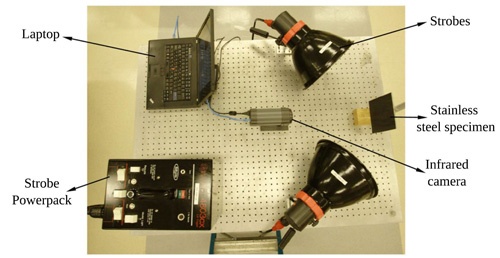
The determination of defect depth and size using Pulsed Infrared Thermography is a critical problem. The problem of defect depth estimation has been previously studied using 1D heat conduction models. Unfortunately, 1D heat conduction based models are generally inadequate in predicting heat flow around defects. In this study, a novel approach based on virtual heat sources is proposed to model heat flow around defects accounting for 2D axisymmetric heat conduction. The proposed approach is used to quantitatively determine the defect depth and size. The validity of the model is established using experiments performed on a stainless steel plate specimen with flat bottom holes at different depths.
Additional Information
In the domain of Nondestructive Testing (NDT), Pulsed Infrared Thermography is an attractive technique because of its full-field defect imaging capability. It is suitable for rapid, wide-area inspection of structures. The determination of defect depth and size using Pulsed Infrared Thermography is a critical problem. Previous studies are based on 1D heat conduction models, which are generally inadequate in predicting heat flow around defects. A novel approach based on virtual heat sources is proposed to model heat flow around defects accounting for 2D axisymmetric heat conduction. The proposed approach is used to quantitatively determine the defect depth and size. The validity of the approach is established using experiments performed on a stainless steel plate specimen with flat bottom holes at different depths.