 Advances in Engineering Advances in Engineering features breaking research judged by Advances in Engineering advisory team to be of key importance in the Engineering field. Papers are selected from over 10,000 published each week from most peer reviewed journals.

Significance statement
We fabricated asymmetric parallel arrays of 440 YBa2Cu3O7-d Josephson junctions (JJs) operating coherently and measured their electric transport properties (current I vs voltage V) in the superconducting state in the temperature range (4.5-89) K and in the presence of an applied magnetic field B.
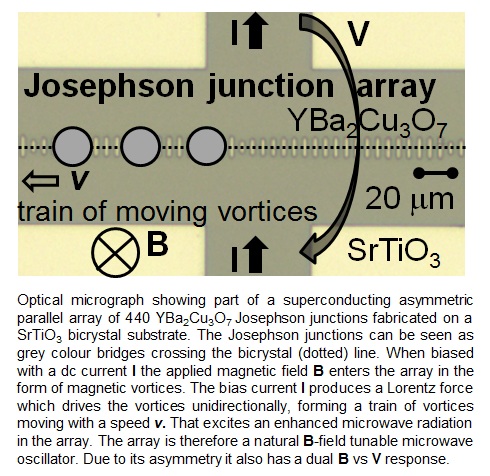
During their operation the magnetic field will enter the arrays in the form of quantized Josephson vortices. The bias current I flowing across the array produces a Lorentz force which drives the Josephson vortices unidirectionally, forming a train of vortices moving with a constant speed v. Due to devices asymmetry the vortex-flow in significantly enhanced in one direction and strongly suppressed in the opposite direction. The vortex-flow is accompanied by an emission of small amplitude electromagnetic (EM) waves that propagate along the array. When the vortex spacing is commensurate with the wavelength of emitted EM waves, resonant modes occur. The experimental signature of such resonant modes between a train of propagating vortices and their induced EM radiation is a series of current resonances in the measured current-voltage characteristics. On a resonant current step, moving vortices couple to their induced EM waves. Further increases of the current do not lead to further linear increases in the vortices velocity, because the energy is consumed in amplifying the EM waves. Such resonances have been observed by many groups, below 9K, in JJ arrays made of low temperature superconductors. The associated amplified EM radiation has been measured too, proving that JJ arrays are suitable candidates as B-tunable microwave oscillators. In a recent publication (B. Chesca, et al., Supercond. Sci. Technol. 27, 085015 (2014)) we report the first observation of vortex-flow-induced current resonances at 77K and above in our asymmetric parallel arrays of YBa2Cu3O7-d JJs. Consequently, our asymmetric design shows great promise as a route to realizing high performance B-field tunable superconducting microwave oscillators operating at relatively high temperatures and relying on low-cost cooling procedures.
The devices show a remarkable B-field tunability of the amplified EM’s frequency which can be well understood considering their record B-field sensitivity (see B. Chesca, et al., Appl. Phys. Lett. 103, 092601 (2013)).
Due to their asymmetry the devices also show a dual magnetic field-to-voltage V(B) response. For negative I they operate like B field-interferometers having a rather sinusoidal response. In contrast, for positive I the devices response voltage remain periodic but highly non-sinusoidal due to the interplay between multiple current resonant modes.
Supercond. Sci. Technol. 27 055019. (2014).
Boris Chesca1, Daniel John1 and Christopher J Mellor2
1 Department of Physics, Loughborough University, Loughborough, UK.
2 School of Physics and Astronomy, Nottingham University, Nottingham, UK.
Abstract
We fabricated a parallel array of 440 YBa2Cu3O7−δ bicrystal grain boundary Josephson junctions having an inductive asymmetric loop configuration within the array. Families of current–voltage characteristics (IVCs) have been measured in the temperature range (4.7–92) K for various values of a magnetic flux applied via a control current Ictrl. For both positive and negative current biases, Icurrent-driven chains of magnetic vortices are propagating along the array producing flux-flow current resonances on the IVCs. However, at 77 K and above, due to the system’s inductive asymmetry the flux flow is suppressed (enhanced) for negative (positive) I. Consequently, the system shows a dual flux-to-voltage response. For negative I it operates like a flux-interferometer having a rather sinusoidal V (Ictrl) response. In contrast, for positive I the device’s response V (Ictrl) remains periodic but highly non-sinusoidal due to the interplay between multiple flux-flow modes. Below 60 K such a dual behaviour is far less pronounced as a result of flux-flow modes being suppressed due to a decrease of the dissipation coefficient with temperature.