Advances in Engineering Advances in Engineering features breaking research judged by Advances in Engineering advisory team to be of key importance in the Engineering field. Papers are selected from over 10,000 published each week from most peer reviewed journals.

Journal of Applied Polymer Science, Volume 128, Issue 5, pages 2595–2603, 2013.
Edgar J. López-Naranjo, Liliana M. Alzate-Gaviria, Galdy Hernández-Zárate, Javier Reyes-Trujeque, Carlos V. Cupul-Manzano, Ricardo H. Cruz-Estrada.
Centro de Investigación Científica de Yucatán, Unidad de Materiales, Calle 43 Número 130, Colonia Chuburná de Hidalgo, CP 97200, Mérida, Yucatán, México and
Centro de Investigación Científica de Yucatán, Unidad de Energía Renovable, Calle 43 Número 130, Colonia Chuburná de Hidalgo, CP 97200, Mérida, Yucatán, México and
Instituto Tecnológico de Boca del Río, Área de Biología Molecular, Km 12 Carretera Veracruz-Córdoba, CP 94290, Boca del Río, Veracruz, México and
Universidad Autónoma de Campeche, Centro de Investigación en Corrosión, Avenida Agustín Melgar S/N entre Calle 20 y Juan de la Barrera, Colonia Buenavista, CP 24039, Campeche, Campeche, México.
Abstract
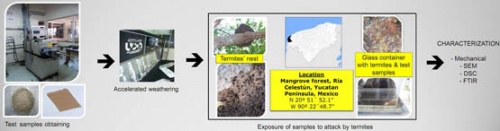
Wood–plastic composites (WPCs) are considered to be highly durable materials and immune to any type of biological attack. However, when one of these composites is exposed to accelerated weathering, its surface is affected by the appearance of cracks, which constitute an ideal access route for biotic agents. Although the destruction of wood caused by termites is recognized worldwide, information on their effects on WPC-based products is scarce. Thus, in this study, we aimed to examine the effects of termite attacks on weathered and nonweathered pinewood residue/recycled high-density polyethylene composites. In this study, WPCs with 40 wt % wood were prepared. Test samples obtained by compression molding and profile extrusion were subjected to weathering cycles for 1000 and 2000 h with a UV-type accelerated tester equipped with UVA-340 fluorescent lamps. Afterward, specimens were exposed to the attack of higher termites (Nasutitermes nigriceps) native to the Yucatan Peninsula. Subsequently, flexural mechanical essays, Fourier transform infrared (FTIR) spectroscopy, differential scanning calorimetry (DSC), and scanning electron microscopy (SEM) analyses were performed. FTIR spectroscopy and DSC showed that the surfaces of the compression-molded specimens were degraded to a higher extent because of the accelerated weathering. The microscopy results revealed that severe damage was caused by the termites on the surface of the compression-molded samples. Statistical analysis of the mechanical test results showed that biotic attack produced significant changes in the samples previously exposed to accelerated weathering. The results show that the processing method directly affected the sample performance because of differences in the surface composition. The profile-extruded composites seemed to better resist termite attack. © 2012 Wiley Periodicals, Inc. J. Appl. Polym. Sci., 2013.
Copyright © 2012 Wiley Periodicals, Inc.
Additional Information
This work is aimed to study the effects of termite attack on weathered and non-weathered pinewood residues/recycled high density polyethylene (HDPE) composites. To meet the aims of this work, test samples obtained by compression molding and profile extrusion were used. Samples were subjected to weathering cycles using an Ultraviolet-type accelerated tester. Afterwards, the specimens were exposed to the attack of higher termites (Nasutitermes nigriceps) native to the Yucatan Peninsula. Flexural mechanical essays, and Fourier transform infrared spectroscopy (FTIR), differential scanning calorimetry (DSC), and scanning electron microscopy (SEM) analyses were performed to evaluate changes in the materials’ properties due to the biotic and abiotic degradation processes studied. It should be mentioned that wood-plastic composites (WPCs) are important materials used to manufacture outdoor products such as decking, fencing and siding, among many others. Although they are promoted as low maintenance and high durable materials, it is a fact that they can be affected by a variety of biotic and abiotic agents that affect their mechanical performance, among many other properties of interest. Thus, information related to this topic will help to better understand the mechanisms of these degradation processes in order to develop WPCs based products with better characteristics. The results are significant because a biotic agent (i.e., termites) whose effects on WPCs are not yet well known was used. Thus, the information reported in this paper would aid to better understand the behavior of this kind of composite materials when used in outdoor applications and exposed to potential attack by termites. Furthermore, in this particular case the materials we experimented with, are intended to be used as structural materials in the Yucatan Peninsula. That is why Nasutitermes nigriceps termites were used because they are native to this region and constitute a potential threat for these materials. The severity of termite attack on WPCs depends on their surface composition, which in turn is related to the processing method used to obtain them. In this particular case, the processing method plays an important role because it affects the amount of plastic present on the materials surface, which in the end acts as a barrier protecting wood from different weather factors that affect the materials mechanical performance.