Advances in Engineering Advances in Engineering features breaking research judged by Advances in Engineering advisory team to be of key importance in the Engineering field. Papers are selected from over 10,000 published each week from most peer reviewed journals.

Journal of Elasticity, 2014, Volume 115, Issue 2, pp 193-224.
Nicolas Clauvelin1, Wilma K. Olson2, Irwin Tobias3.1. BioMaPS Institute for Quantitative Biology, Rutgers, the State University of New Jersey, Piscataway, USA and
2. BioMaPS Institute for Quantitative Biology and Department of Chemistry and Chemical Biology, Rutgers, the State University of New Jersey, Piscataway, USA and
3. Department of Chemistry and Chemical Biology, Rutgers, the State University of New Jersey, Piscataway, USA.
Abstract
We present the small-amplitude vibrations of a circular elastic ring with periodic and clamped boundary conditions. We model the rod as an inextensible, isotropic, naturally straight Kirchhoff elastic rod and obtain the vibrational modes of the ring analytically for periodic boundary conditions and numerically for clamped boundary conditions. Of particular interest are the dependence of the vibrational modes on the torsional stress in the ring and the influence of the rotational inertia of the rod on the mode frequencies and amplitudes. In rescaling the Kirchhoff equations, we introduce a parameter inversely proportional to the aspect ratio of the rod. This parameter makes it possible to capture the influence of the rotational inertia of the rod. We find that the rotational inertia has a minor influence on the vibrational modes with the exception of a specific category of modes corresponding to high-frequency twisting deformations in the ring. Moreover, some of the vibrational modes over or undertwist the elastic rod depending on the imposed torsional stress in the ring.
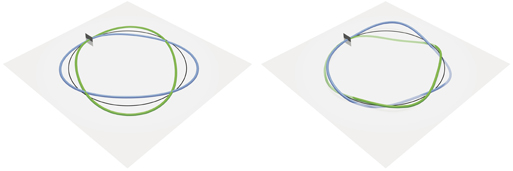
Figure Legend:
Three-dimensional shapes of a flexural normal mode of vibration for a clamped elastic ring with (left) and without (right) an imposed torsional moment. In both cases, the extremum shapes (i.e., the maximum and minimum of the oscillation) are represented in blue and green. The light shading represents the parts of the ring below the gray plane, which denotes the horizontal plane. The dark line on this plane represents the planar undeformed elastic ring.