 Advances in Engineering Advances in Engineering features breaking research judged by Advances in Engineering advisory team to be of key importance in the Engineering field. Papers are selected from over 10,000 published each week from most peer reviewed journals.

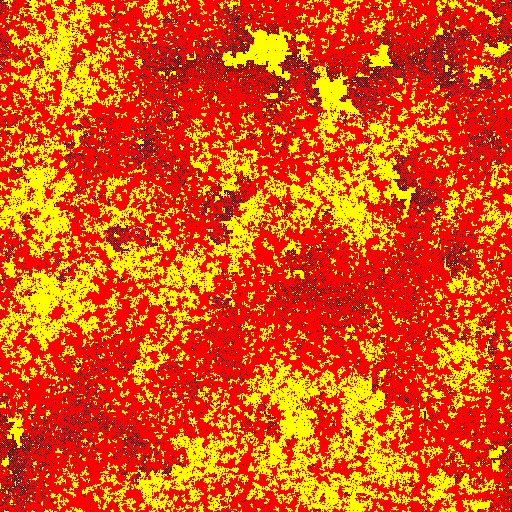

Figure Legend
Typical 2D snapshots of the LLC process (top panel) and LLC process with diffusive rewiring (bottom panel). Yellow colour represents species X1 (prey), black colour represents species X2 (predators), and red colour represents virtual species S. In both cases the interactions take place on square lattices of size 512 x 512 and the kinetic rates are k1 = 30.0, k2 = 0.5 and k3 = 0.8. Both systems are integrated for 1000 Monte Carlo Steps starting from the same initial conditions. In the top panel the diffusion to reaction rate r is r = pd/(1 − pd) = 0.1. Typical clustering is observed in the top panel due to species segregation caused by the reactive process. The clusters break in the bottom panel due to the introduction of small diffusive rewiring.
Journal Reference
The European Physical Journal B, 2013, 86:277.
E. Panagakou, G. C. Boulougouris, A. Provata.
Department of Physical Chemistry, National Center for Scientific Research “Demokritos”, 15310, Athens, Greece and
Department of Physics, University of Athens, 15771, Athens, Greece and
Department of Molecular Biology and Genetics, Democritus University of Thrace, 68100, Alexandroupolis, Greece.
Abstract
The dynamics of stochastic nonlinear kinetic schemes is known to deviate from the mean field (MF) theory when restricted on low dimensional spatial supports. This failure has been attributed to (i) the influence of the support’s spatial extension which modifies the system’s dynamics and (ii) the influence of the noise. In the current study, we introduce effective parameters, which depend on the type of the support and which allow for an effective MF description. As working example the lattice limit cycle dynamics is used, restricted on a 2D square lattice with nearest neighbour interactions. We show that it is possible to describe the spatiotemporal average concentrations of the restricted dynamics using the MF model when the kinetic rates are replaced with their effective values. The same conclusion holds when reactive stochastic rewiring is introduced in the system via long distance coupling. Instead, when the stochastic coupling becomes diffusive the effective parameters no longer predict the steady state. This is attributed to the diffusion process which is an additional factor introduced into the dynamics and is not accounted for, in the kinetic MF scheme.