 Advances in Engineering Advances in Engineering features breaking research judged by Advances in Engineering advisory team to be of key importance in the Engineering field. Papers are selected from over 10,000 published each week from most peer reviewed journals.

Ping Du, Xiaoning Wang, I.-Kuan Lin, Xin Zhang
Sensors and Actuators A: Physical, Volume 176, April 2012
Abstract
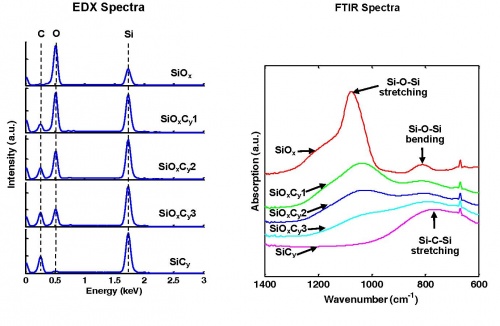
There is an increasing trend to incorporate silicon carbide (SiC) into silicon oxides to improve the mechanical properties, thermal stability, and chemical resistance. In this work the silicon oxycarbide (SiOC) films were deposited by RF magnetron co-sputtering from silicon dioxide and silicon carbide targets. Subsequently rapid thermal annealing was applied to the as-deposited films to tune the mechanical properties. Energy dispersive spectroscopy, scanning electron microscopy, Fourier transform infrared spectroscopy and ellipsometry were employed to characterize the compositions and microstructure of the films. The residual stress of the films was calculated from the film–substrate curvature measurement using Stoney’s equation. The film stress changed from compressive to tensile after annealing, and it generally increased with carbon contents. The Young’s modulus and hardness were investigated by the depth-sensing nanoindentation, which were found to increase with the carbon content and annealing temperature. A thorough microstructural analysis was conducted to investigate the effect of carbon content and annealing temperature on the mechanical properties of SiOC films.
Go to Journal