Advances in Engineering Advances in Engineering features breaking research judged by Advances in Engineering advisory team to be of key importance in the Engineering field. Papers are selected from over 10,000 published each week from most peer reviewed journals.

Journal of Alloys and Compounds, 556 (2013) 127-134.
Q. Cao, L. S. Chumbley, Y. Mudryk , M. Zou, V. K. Pecharsky, K. A. Gschneidner Jr.
Ames Laboratory, Iowa State University, Ames, IA 50011-3020, USA &
Department of Materials Science and Engineering, Iowa State University, Ames, IA 50011-2300, USA
Abstract
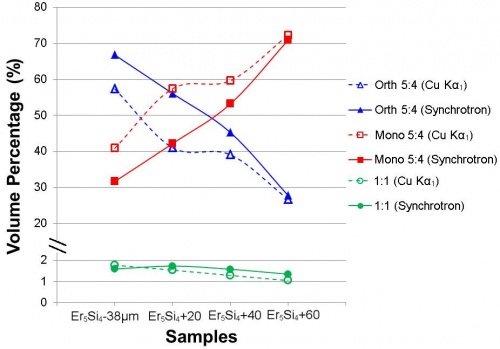
The effect of mechanical grinding and subsequent low temperature annealing on the orthorhombic to monoclinic structural transition in the Er5Si4 compound was studied by X-ray powder diffraction using both a conventional laboratory Cu Kα1 radiation and a high-energy synchrotron source. A reversible phase transition from the orthorhombic to monoclinic structure occurs as a result of mechanical grinding. Low temperature annealing reverses the transformation and converts the formed monoclinic phase back to the orthorhombic, evidently by relieving residual stress introduced during the grinding.
Figure Legned:
Phase concentrations of four powder samples from Er5Si4 #1 obtained using XRD employing both Cu Kα1 radiation and synchrotron radiation.