Advances in Engineering Advances in Engineering features breaking research judged by Advances in Engineering advisory team to be of key importance in the Engineering field. Papers are selected from over 10,000 published each week from most peer reviewed journals.

International Journal of Heat and Mass Transfer, Volume 57, Issue 2, February 2013, Pages 542-548.
Hani Tiznobaik, Donghyun Shin
Department of Mechanical & Aerospace Engineering, The University of Texas at Arlington, Arlington, TX 76019-0023, United States
Abstract
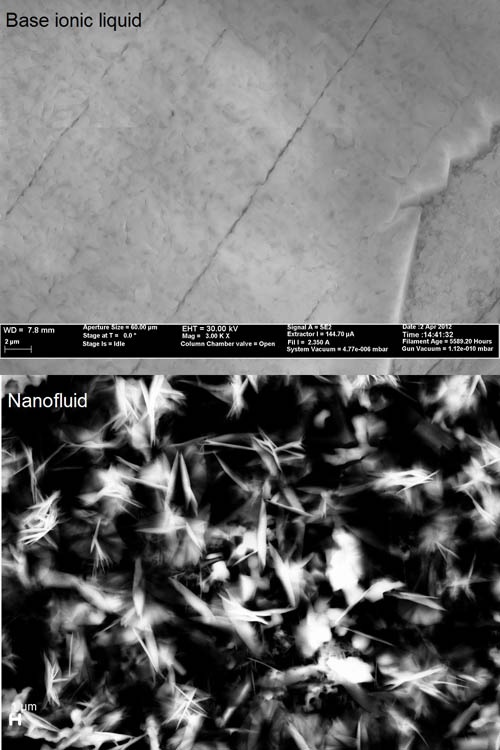
Four different sized silicon-dioxide nanoparticles (5, 10, 30, and 60 nm in diameter) were dispersed in a molten salt eutectic (lithium carbonate and potassium carbonate, 62:38 by molar ratio) to obtain high temperature operating fluids (nanomaterials). A modulated differential scanning calorimeter was employed to measure the specific heat capacity of the molten salt eutectic and nanomaterials (molten salt/nanoparticle mixture). The specific heat capacity of nanomaterials was enhanced by evenly 25% over that of the base molten salt eutectic (base fluid), regardless of the size of embedded nanoparticles. The measurement uncertainty of experiments was less than 5%. Material characteristic analyses using electron microscopy show that the addition of nanoparticles into the molten salt eutectic induces nearby molten salts to form needle-like structures. These special structures were only observed within the nanomaterials whose specific heat capacity was significantly enhanced. The observed enhancements in specific heat capacity can be explained by the high specific surface energies that are associated with the high surface areas of the embedded nanoparticles and the needle-like structures induced by the nanoparticle addition.
Additional Information
Since the end of the last century, many researchers have investigated anomalous thermal properties of nanofluids. Although most attention has been given to enhanced thermal conductivity, not many research efforts have been made on heat capacity. It is commonly understood that nanoparticles in a medium do not have significant impact on this property. However, this study showed that, for ionic liquid, the inclusion of fully oxidized nanoparticles resulted in enhanced heat capacity of the base fluid. It was observed that heat capacity was enhanced ~25-30% by adding a small concentration of nanoparticles (1% by weight) into ionic liquid mixture. From subsequent characterization analysis, the formation of a different phase (in nanometer size; “nanostructure”) was observed at the interfaces between nanoparticle surfaces and surrounding ionic liquid molecules. These nanostructure consists of crystalized ionic liquid separated from the base mixture. Due to the difference in electrostatic interaction between nanoparticle surface (OH- on oxidized surface) and surrounding ionic liquid molecules (+ion), the base ionic liquid mixture can be separated locally near nanoparticles at nanoscale. Then, the base ionic liquid mixture becomes either hypoeutectic or hypereutectic and starts to crystallize on nanoparticle surfaces and grow away from nanoparticles and eventually form nanostructures. These nanostructures have extraordinarily large specific surface area and significantly amplify the contribution of surface phonon energy on the effective heat capacity of ionic liquid-based nanofluids. Using these ionic liquid-based nanofluids for thermal energy storage applications in concentrated solar power systems can dramatically reduce the required amount of TES medium, the size of TES structure, and the size of thermal transport system. Therefore, a large reduction in the cost of electricity is expected.