 Advances in Engineering Advances in Engineering features breaking research judged by Advances in Engineering advisory team to be of key importance in the Engineering field. Papers are selected from over 10,000 published each week from most peer reviewed journals.

Significance statement
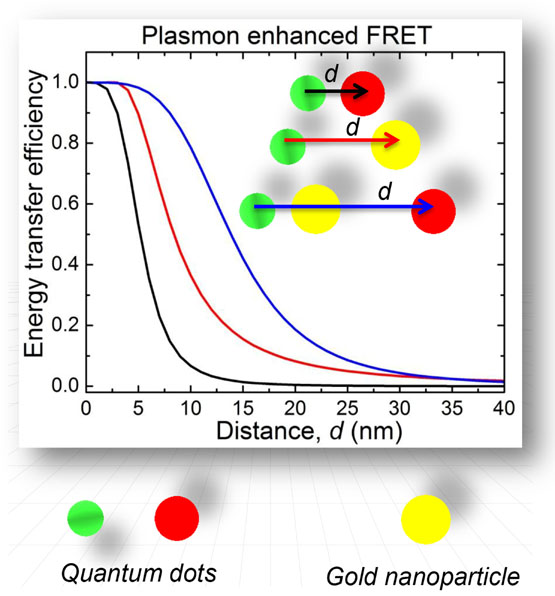
This paper reports on the first direct experimental study of the separation dependence of localised surface plasmon (LSP) coupled non-radiative energy transfer. The results were reported for a test system donor and acceptor quantum dots coupled via Au nanoparticles, but can be extended to other dipole-like emitters and plasmonic structures. It is found that the dependence of the LSP coupled energy transfer efficiency on the donor-acceptor separation can have the same dipole-dipole behaviour as conventional Förster resonance energy transfer (FRET) but with a greatly extended energy transfer distance. It is observed that the strongly coupled donor-plasmon pair behaves as an enhanced donor dipole and the characteristic energy transfer distance can be tuned via the Au nanoparticle concentration. A theoretical model was developed which could fully predict the experimental results. The model was used to probe the relative importance of donor-plasmon and acceptor-plasmon coupling. It is shown that strong donor-plasmon coupling can provide greater enhancement of the FRET mechanism. The conditions for achieving a well-defined distance dependence, which is of importance for applications such as a long range spectroscopic ruler or sensing, are also elucidated. In addition it is demonstrated that significant acceptor emission enhancement, of ~180%, can be achieved via the LSP coupled energy transfer mechanism. These results indicate that LSP coupled FRET could be significant for the development of higher efficiency light emitting device.
ACS Nano, 2014, 8 (2), pp 1273–1283.
Xia Zhang †, Cristian A. Marocico †, Manuela Lunz†, Valerie A. Gerard ‡, Yurii K. Gun’ko ‡, Vladimir Lesnyak §, Nikolai Gaponik ⊥, Andrei S. Susha ∥,Andrey L. Rogach ∥, and A. Louise Bradley †*
† School of Physics and CRANN, Trinity College, Dublin 2, Ireland and
‡ School of Chemistry and CRANN, Trinity College, Dublin 2, Ireland and
§ Istituto Italiano di Tecnologia, Via Morego 30, 16163 Genova, Italy and
⊥ Physical Chemistry, TU Dresden, Bergstrasse 66b, 01062 Dresden, Germany and
∥ Department of Physics and Materials Science & Center for Functional Photonics (CFP), City University of Hong Kong, Hong Kong, China.
Abstract
The distance dependence of localized surface plasmon (LSP) coupled Förster resonance energy transfer (FRET) is experimentally and theoretically investigated using a trilayer structure composed of separated monolayers of donor and acceptor quantum dots with an intermediate Au nanoparticle layer. The dependence of the energy transfer efficiency, rate, and characteristic distance, as well as the enhancement of the acceptor emission, on the separations between the three constituent layers is examined. A d–4 dependence of the energy transfer rate is observed for LSP-coupled FRET between the donor and acceptor planes with the increased energy transfer range described by an enhanced Förster radius. The conventional FRET rate also follows a d–4 dependence in this geometry. The conditions under which this distance dependence is valid for LSP-coupled FRET are theoretically investigated. The influence of the placement of the intermediate Au NP is investigated, and it is shown that donor–plasmon coupling has a greater influence on the characteristic energy transfer range in this LSP-coupled FRET system. The LSP-enhanced Förster radius is dependent on the Au nanoparticle concentration. The potential to tune the characteristic energy transfer distance has implications for applications in nanophotonic devices or sensors
Copyright © 2014 American Chemical Society