 Advances in Engineering Advances in Engineering features breaking research judged by Advances in Engineering advisory team to be of key importance in the Engineering field. Papers are selected from over 10,000 published each week from most peer reviewed journals.

Yasser Aboelkassem and Anne E. Staples
Acta Mechanica, Volume 223, Number 3, 2012
Abstract
A novel micropumping mechanism based on a theoretical model that describes flow transport in a microchannel induced by moving wall contractions in the low Reynolds number flow regime is presented. The channel is assumed to have a length that is much greater than its width (d = W/L << 1) and the upper wall is subjected to prescribed, non-peristaltic, localized moving contractions. Lubrication theory for incompressible viscous flow at low Reynolds number (R e ~ δ) is used to model the problem mathematically and to derive expressions for the velocity components, pressure gradient, wall shear stress, and net flow produced by the wall contractions. The effect of contraction parameters such as amplitude and phase lag on the time-averaged net flow over a single cycle of wall motions is studied. The results presented here are supported by passive particle tracking simulations to investigate the possibility of using this system as a pumping mechanism. The present study is motivated by collapse mechanisms observed in entomological physiological systems that use multiple contractions to transport fluid, and the emerging novel microfluidic devices that mimic these systems.
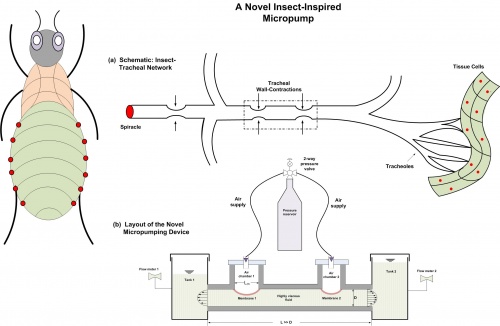
An Insect-Inspired Micropump: Bioinspiration and biomimetics are two increasingly important fields in applied science and mechanics that seek to imitate systems or processes in nature to design improved engineering devices. Here, we are inspired and motivated by microscale internal flow transport phenomena in insect tracheal networks, which are observed to be induced by the rhythmic tracheal wall contractions. These networks have been shown to manage fluid very efficiently compared to current state-of-the-art microfluidic devises.
This article presents a novel bioinspired pumping mechanism that is neither peristaltic nor belongs to impedance mismatch class of pumping mechanisms. The insect-inspired pumping models presented here are expected to function efficiently in the microscale flow regime in simple channel/tube geometries or a complex network of channels. The first pumping approach shows the ability of inducing a unidirectional net flow by using an inelastic tube or channel with at least two moving contractions. A schematic that shows the prospective design of our new pumping paradigm is shown in this figure.
Go to Journal