Advances in Engineering Advances in Engineering features breaking research judged by Advances in Engineering advisory team to be of key importance in the Engineering field. Papers are selected from over 10,000 published each week from most peer reviewed journals.

Optics Express , Volume 21 , Issue 10 , Page 11928. (2013).
Roberto Lopez-Boada, Charles J. Regan, Daniel Dominguez, Ayrton. A. Bernussi, and Luis Grave de Peralta.
ACE, Barry University, Miami Shores, FL 33161, USA and
Department of Electrical and Computer Engineering, Texas Tech University, Lubbock, TX 79409, USA and
Nano Tech Center, Texas Tech University, Lubbock, TX 79409, USA and
Department of Physics, Texas Tech University, Lubbock, TX 79409, USA.
Abstract
We present a general discussion about the fundamental physical principles involved in a novel class of optical superlenses that permit to realize in the far-field direct non-scanning images with subwavelength resolution. Described superlenses are based in the illumination of the object under observation with surface waves excited by fluorescence, the enhanced transmission of fluorescence via coupling with surface waves, and the occurrence of far-field coherence-related fluorescence diffraction phenomena. A Fourier optics description of the image formation based on illumination with surface waves is presented, and several recent experimental realizations of this technique are discussed. Our theoretical approach explains why images with subwavelength resolution can be formed directly in the microscope camera, without involving scanning or numerical post-processing. While resolution of the order of λ/7 has been demonstrated using the described approach, we anticipate that deeper optical subwavelength resolution should be expected.
© 2013 OSA
Additional information:
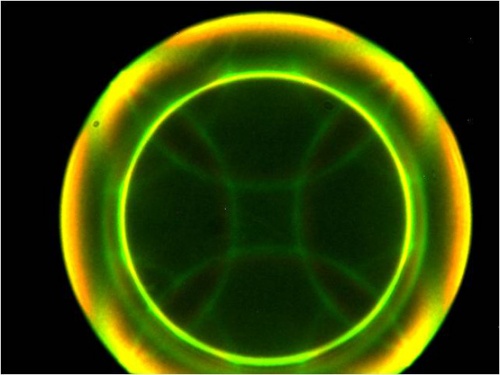
The far-field optical superlenses based on illumination with surface waves described in this featured article works as advanced ultra-thin condensers (UTC) allowing optical subwavelength resolution microscopy. Compared with traditional microscope condensers, formed by bulky lenses (or mirrors) and diaphragms, these superlenses are compact, easier to use, and inexpensive; therefore, disposable. The beautiful bright rings observed in the Fourier plane (FP) images obtained using UTCs are the signature of a microscope condenser that illuminates the sample with surface waves. When the object under observation is a periodic array, an image of the array is formed in the real plane of the microscope if, and only if, at least a fraction of additional shifted rings appear in the FP images obtained with the superlens. This is because the diffraction pattern, obtained when a periodic array is illuminated by the hollow cone of light produced by a microscope condenser, is not formed by spots but by rings. Rings are larger than spots; therefore, a fraction of the first order diffraction rings are easier to collect by the microscope objective lens than first order diffraction spots. This is the reason why superlenses based on illumination with surface waves, or shortly UTCs, produce optical subwavelength resolution. Due to the non-linear dispersion of surface plasmon polaritons (SPP), it is in principle possible to conceive a plasmonic UTC where dark SPPs are excited with extremely large momentum values. Such dark SPPs would not be able to leak to the objective lens of the microscope except when scattered by the presence of nanofeatures, so small, that contain spatial frequencies too large for being observable with traditional Rayleigh-resolution-limited optical microscopes. Therefore, such plasmonic UTCs would allow the development of breakthrough dark-field non-scanning optical microscopy techniques with deep subwavelength resolution.