Advances in Engineering Advances in Engineering features breaking research judged by Advances in Engineering advisory team to be of key importance in the Engineering field. Papers are selected from over 10,000 published each week from most peer reviewed journals.

Microfluidics and Nanofluidics Journal Volume 16, pp. 779–785. (2014).
J. Berthier, K.A. Brakke, E. Berthier.
Université Grenoble Alpes, F-38000, Grenoble, France and CEA, LETI, MINATEC Campus, F-38054, Grenoble, France &
Mathematics Department, Susquehanna University, 514 University Avenue, Selinsgrove, PA 17870, USA, &
Department of Medical Microbiology andImmunology, University of Wisconsin-Madison, Madison, WI53705, USA.
Abstract
There is a trend in biotechnology to evolve towards passive systems that do not require the use of auxiliary energy sources, such as pumps, automated syringes, electric plugin, etc., which are the characteristics of active systems. These passive systems use the principle of capillarity to move the fluids. In fact, the energy source for the flow is the surface energy of the different components, energy which is “built in” with the device. Such systems become easily portable, user-friendly, very low cost, and compatible with telemedicine. They can be used at the doctor’s office and even reach a wide scan of the people, in their own homes. They are usually called point-of-care (POC) or home-care systems.
So far there was no criterion available to predict the spontaneous capillary flow in composite microchannels. In this work, a novel criterion for the onset of capillary motion in composite channels, covered or open, of uniform cross-section is derived from the Gibbs free energy. It is shown that spontaneous capillary flow (SCF) occurswhen the generalized Cassie angle along the perimeter of a cross section of the channel is smaller than 90°. The generalized Cassie angle is defined in the same manner as the usual Cassie angle with the convention of an equivalent contact angle of 180° for an open boundary (with air).
Evidently this relation collapses tothe well-known hydrophilic contact angle 90° in the case of a homogeneous confined channel. But the relation shows that a capillary flow can occur even if a part of the cross-section perimeter is not lyophilic. It can be the case of an open-surface microflow—when a part of the liquid boundary is the surrounding air—, or even a suspended microflow—where surface tension is used to fill and maintain a fluid in microscale structures devoidof a ceiling and floor.
The theoretically determined SCF criterion has been checked numerically by using the Surface Evolver software. This software does not describe the dynamics of fluid motion, but iteratively relocates the interface to lower the energy. In the case of SCF, no equilibrium location exists, but we can use Evolver to predict the motion. On the other hand, an experimental device has been set up, based on a dimensioning performed with the theoretical SCF criterion, showing the possibility to build matrices of collagen uDOTS.
Figure Legend
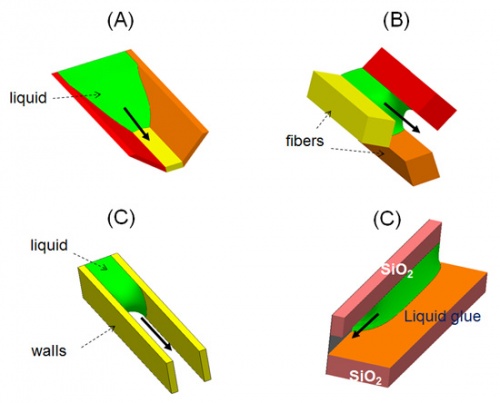
Different cases of spontaneous capillary flows calculated with the Surface Evolver numerical software, in agreement with the theoretical SCF criterion. A: open-surface microflow in a trapezoidal micro-channel with composite walls; B: capillary microflow between three different fibers; C: suspended microflow between two parallel walls; D: a microflow of liquid glue during the deposition of the cover of a microsystem (last image from J. Berthier, K. Brakke, The physics of microdroplets. Scrivener-Wiley Publishing, 2012).