Advances in Engineering Advances in Engineering features breaking research judged by Advances in Engineering advisory team to be of key importance in the Engineering field. Papers are selected from over 10,000 published each week from most peer reviewed journals.

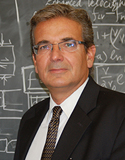
Advances in Engineering Team congratulate the 2013 Nobel Laureates in Physics, François Englert and Peter W. Higgs “for the theoretical discovery of a mechanism that contributes to our understanding of the origin of mass of subatomic particles”.
The electroweak theory, which unifies the electromagnetic and weak interactions of elementary particles, has, since 1970, received experimental support to a precision unprecedented in the history of science. This unification involves a close relationship between the massless photon, which carries the long-range electromagnetic force, and the W and Z vector bosons, which carry the short-range weak force and must therefore be very massive. Prior to the invention of the Higgs mechanism, it was not known how to formulate a consistent relativistic field theory with a local symmetry which could contain both massless and massive force carriers.
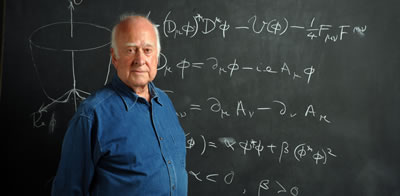
In 1962, Goldstone’s theorem had shown that spontaneous breaking of symmetry in a relativistic field theory results in massless spin-zero bosons, which are excluded experimentally. In a paper published in Physics Letters on 15 September 1964, Peter Higgs showed that Goldstone bosons need not occur when a local symmetry is spontaneously broken in a relativistic theory(1). Instead, the Goldstone mode provides the third polarisation of a massive vector field. The other mode of the original scalar doublet remains as a massive spin-zero particle – the Higgs boson.
Higgs wrote a second short paper describing what came to be called “the Higgs model” and submitted it to Physics Letters, but it was rejected on the grounds that it did not warrant rapid publication. Higgs revised the paper and submitted it to Physical Review Letters, where it was accepted (2), but the referee, who turned out to be Yoichiro Nambu (Nobel Prize Winner), asked Higgs to comment on the relation of his work to that of Francois Englert and Robert Brout, which was published in Physical Review Letters on 31 August 1964, the same day his paper was received. Higgs had been unaware of their work, because the Brussels group did not send preprints to Edinburgh. Higgs’ revised paper drew attention to the possibility of a massive spin-zero boson in its final paragraph. During October 1964, Higgs had discussions with Gerald Guralnik, Carl Hagen and Tom Kibble, who had discovered how the mass of non-interacting vector bosons can be generated by the Anderson mechanism (4).
The previous year, Philip Anderson had pointed out that, in a superconductor where the local gauge symmetry is broken spontaneously, the Goldstone (plasmon) mode becomes massive due to the gauge field interaction, whereas the electromagnetic modes are massive (Meissner effect) despite the gauge invariance5. However, he did not discuss any relativistic model and so, since Lorentz invariance was a crucial ingredient of the Goldstone theorem, he did not demonstrate that it could be evaded. In Higgs’ second 1964 paper (2) he referred to Anderson’s work in a way which implied that Anderson knew about the non-relativistic counterpart of the Higgs boson. In fact, Anderson didn’t and it was not until 1981 that an unexpected feature of the Raman spectrum of NbSe2 was understood to be due to “a massive collective mode which exists in all superconductors – the oscillation of the amplitude of the superconducting gap” (6), the only Higgs boson so far to be discovered experimentally.
The search for the Higgs boson has become a major objective of experimental particle physics. Although the best fit to all the electroweak precision measurements gives its mass between 52 and 110 GeV, it has been excluded below 114 GeV. Its mass cannot exceed 1 TeV if the electroweak theory itself is to remain valid up to this energy scale, precisely the range that is being explored by CERN’s Large Hadron Collider. Higgs’ work has been a crucial step towards a unified theory of the forces of Nature and is the basis for an experimental programme which is guaranteed to discover new physics.
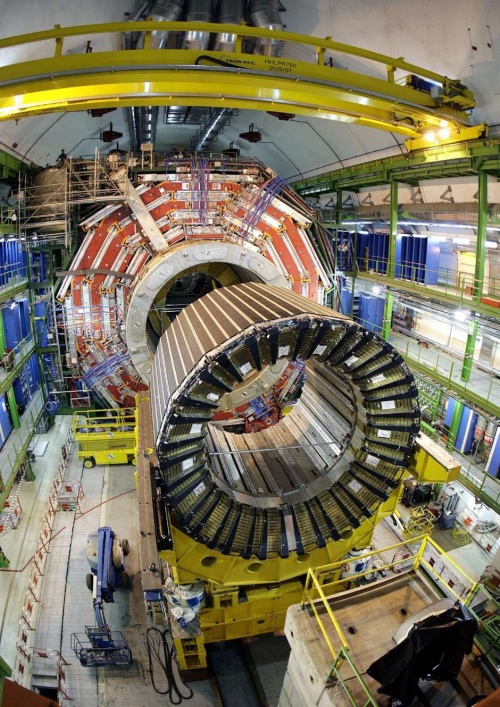
CERN uses a giant underground laboratory where protons are smashed together at nearly the speed of light, yielding sub-atomic debris that is then scrutinised for signs of the fleeting Higgs.
The task is arduous because there are trillions of signals, occurring among particles at different ranges of mass. The Higgs has been dubbed the “God particle” because it is powerful and ubiquitous yet so hard to find.
Over the years, tens of thousands of physicists and billions of dollars have been thrown into the search, gradually narrowing down the mass range where it might exist.
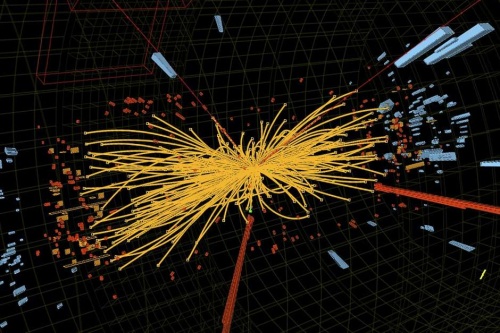
Two CERN laboratories, working independently of each other to avoid bias, found the new particle in the mass region of around 125-126 Gigaelectronvolts (GeV), according to data they presented on Wednesday.
Both said that the results were “five sigma,” meaning there was just a 0.00006 percent chance that what the two laboratories found is a mathematical quirk (%99.99997 accuracy).
The significance of the discovery was nicely commented by Professor Sir Peter Knight, President of the Institute of Physics (IOP) who said: “This is the physics version of the discovery of DNA. It sets the course for a brand new adventure in our efforts to understand the fabric of our Universe.”
This is a remarkable achievement. Fifteen years of international collaboration and hard work constructing the Large Hadron Collider has paid off.
Akin to a Moon mission, one of the most remarkable things about the hunt for the Higgs is how the effort has caught the public imagination.
Not since the Apollo missions 40 years ago has there been such a sense of popular excitement around scientific discovery. Long may this continue to inspire the next generation of scientists.”
REFERENCES:
(1) P.W. Higgs, Phys. Lett. 12 (1964) 132
(2) P.W. Higgs, Phys. Rev. Lett. 13 (1964) 508
(3) F. Englert and R. Brout, Phys. Rev. Lett. 13 (1964) 321
(4) G.S. Guralnik, C.R. Hagen and T.W.B. Kibble, Phys. Rev. Lett. 13 (1964) 585
(5) P.W. Anderson, Phys. Rev. 130 (1963) 439
(6) P.B. Littlewood and C.M. Varma, Phys. Rev. Lett. 47 (1981) 811