 Advances in Engineering Advances in Engineering features breaking research judged by Advances in Engineering advisory team to be of key importance in the Engineering field. Papers are selected from over 10,000 published each week from most peer reviewed journals.

Significance Statement
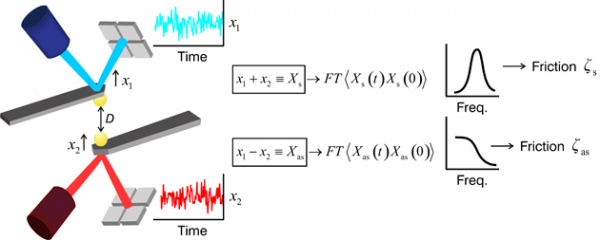
Atomic force microscopy (AFM) was developed as a high-resolution imaging tool but has subsequently been used as a force spectrometer and a microrheometer. Despite great progress, AFM has always been limited by inherent noise: the random thermal noise in cantilever deflection that is dictated by interactions with the surrounding molecules. In this paper, we use the approach of correlation force spectroscopy (CFS) on a pair of closely-spaced cantilevers with a sphere attached to the distal end of each cantilever to yield new physical insights into the fluid interactions between small particles. The thermal noise of a correlation measurement of a cantilever pair is lower than the thermal noise of a single cantilever measurement. Additionally, the hydrodynamic drag force is lessened due to the reduction of the surface of interaction. In this article we extend the use of CFS in the areas of microrheological and colloidal applications. This was accomplished by adding a micro-sphere to the distal end of each cantilever and then measuring the thermal fluctuations in cantilever displacement for each cantilever (x1 and x2). This measurement allowed us to probe the interactions between two closely spaced spheres at high frequency in a viscous fluid. The analysis was simplified by considering the symmetric (X s ≡ x1 + x2) and asymmetric (X as ≡ x1 – x2) modes, from which the power spectra (given by a Fourier Transform of the correlation function) were used to obtain the friction in each mode (ζ s and ζ as). We then determined the viscosity of the intervening fluid by analyzing the hydrodynamic interactions of the particles. Our experiments showed that, despite the high frequency of oscillation of each sphere (due to its attachment to a cantilever), fluid inertia was not significant when the particles were close together because of the high fluid friction in the narrow gap between the particles. This simplifies the prediction of the fluid forces and also provides an improved understanding of the dynamics of concentrated colloidal dispersions. We introduced an interparticle frequency number that can be used to determine when the effects of fluid inertia are important. Our results find application in understanding the motion of concentrated colloidal suspensions as well as in the development of technologies such as the electroacoustic determination of the zeta potential and particle size.
Journal Reference
Milad Radiom1, Brian Robbins2, Mark Paul2 , William Ducker1. Phys. Fluids 27, 022002 (2015);
[expand title=”Show Affiliations”]1 Department of Chemical Engineering, Virginia Tech, Blacksburg, Virginia 24060, USA
2 Department of Mechanical Engineering, Virginia Tech, Blacksburg, Virginia 24060, USA
[/expand]Abstract
The hydrodynamic interaction of two closely spaced micron-scale spheres undergoing Brownian motion was measured as a function of their separation. Each sphere was attached to the distal end of a different atomic force microscopy cantilever, placing each sphere in a stiff one-dimensional potential (0.08 Nm−1) with a high frequency of thermal oscillations (resonance at 4 kHz). As a result, the sphere’s inertial and restoring forces were significant when compared to the force due to viscous drag. We explored interparticle gap regions where there was overlap between the two Stokes layers surrounding each sphere. Our experimental measurements are the first of their kind in this parameter regime. The high frequency of oscillation of the spheres means that an analysis of the fluid dynamics would include the effects of fluid inertia, as described by the unsteady Stokes equation. However, we find that, for interparticle separations less than twice the thickness of the wake of the unsteady viscous boundary layer (the Stokes layer), the hydrodynamic interaction between the Brownian particles is well-approximated by analytical expressions that neglect the inertia of the fluid. This is because elevated frictional forces at narrow gaps dominate fluid inertial effects. The significance is that interparticle collisions and concentrated suspensions at this condition can be modeled without the need to incorporate fluid inertia. We suggest a way to predict when fluid inertial effects can be ignored by including the gap-width dependence into the frequency number. We also show that low frequency number analysis can be used to determine the microrheology of mixtures at interfaces.
© 2015 AIP Publishing LLC