Advances in Engineering Advances in Engineering features breaking research judged by Advances in Engineering advisory team to be of key importance in the Engineering field. Papers are selected from over 10,000 published each week from most peer reviewed journals.

Proc Natl Acad Sci U S A. 2014 Apr 1;111(13):4803-8.
Jenkins IC, Casey MT, McGinley JT, Crocker JC, Sinno T.
Department of Chemical and Biomolecular Engineering, University of Pennsylvania, Philadelphia, PA 19104.
ABSTRACT
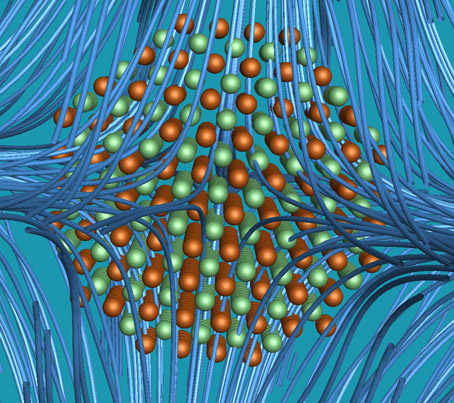
The degree to which DNA-linked particle crystals, particularly those composed of micrometer-scale colloids, are able to dynamically evolve or whether they are kinetically arrested after formation remains poorly understood. Here, we study a recently observed displacive transformation in colloidal binary superlattice crystals, whereby a body-centered cubic to face-centered cubic transformation is found to proceed spontaneously under some annealing conditions. Using a comprehensive suite of computer simulation tools, we develop a framework for analyzing the many displacive transformation pathways corresponding to distinct, but energetically degenerate, random hexagonal close-packed end states. Due to the short-ranged, spherically symmetric nature of the particle interactions the pathways are all barrierless, suggesting that all end states should be equally likely. Instead, we find that hydrodynamic correlations between particles result in anisotropic mobility along the various possible displacive pathways, strongly selecting for pathways that lead to the fcc-CuAu-I configuration, explaining recent experimental observations. This finding may provide clues for discovering new approaches for controlling structure in this emerging class of materials.
Figure: Credit of University of Pennsylvania.