Advances in Engineering Advances in Engineering features breaking research judged by Advances in Engineering advisory team to be of key importance in the Engineering field. Papers are selected from over 10,000 published each week from most peer reviewed journals.

Journal of Alloys and Compounds, 26 February 2013.
J. Cizek, F. Lukác, M. Vlcek, O. Melikhova, F. Traeger, D. Rogalla, H.-W. Becker
Charles University in Prague, Faculty of Mathematics and Physics, V Holesovickách 2, CZ-180 00 Praha 8, Czech Republic
Physikalische Chemie I, Ruhr-Universitat Bochum, Universitaetsstr. 150, D-44801 Bochum, Germany
Abstract
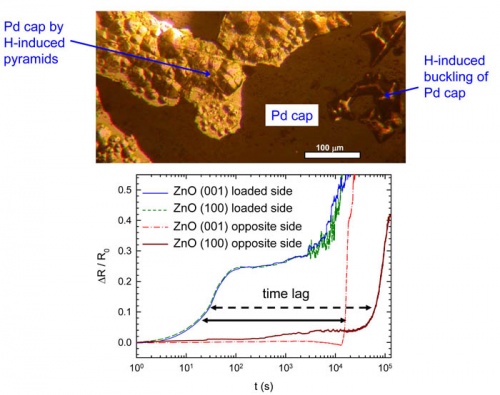
ZnO single crystals electrochemically charged with hydrogen were characterized. The concentration of hydrogen introduced into the crystals was determined by nuclear reaction analysis and was found to be in a reasonable agreement with the value estimated from the Faraday’s law. Moreover, a sub-surface layer with very high concentration of hydrogen and very high density of open-volume defects was formed by plastic deformation caused by hydrogen-induced stress. Specific surface modification caused by hydrogen-induced slip in the c-direction was observed on hydrogen loaded crystals. Hydrogen diffusion coefficient in ZnO was estimated by in situ electrical resistivity measurement. It was found that hydrogen diffusion in the c-direction is faster than in the a-direction most probably due to open channels existing in the wurtzite structure along the c-axis.
Additional Information:
ZnO is a wide band gap semiconductor with large exciton binding energy. Because of its favorable properties ZnO takes great attention as a material for UV light emitting diodes, optoelectronic devices and solar cells. Using ab-inito theoretical calculations Van de Walle [1] predicted that hydrogen is easily incorporated into ZnO lattice and can form a shallow donor state. Later experimental studies revealed that hydrogen is indeed the most important impurity in high quality ZnO crystals and its concentration exceeds the concentration of other impurities by at least one order of magnitude [2]. For these reasons it is very important to understand hydrogen dynamics in ZnO lattice.
We found that a high concentration of hydrogen can be introduced into ZnO relatively easily by electrochemical charging of ZnO samples covered by very thin Pd over-layer [3]. Moreover, we developed a simple method for measurement of hydrogen diffusivity using electrochemical charging combined with electrical resistivity measurement of Pd over-layers covering ZnO samples.
[1] C.G. Van de Walle, Phys. Rev. Lett. 85 (2000) 1012 [2] G. Brauer, W. Anwand, D. Grambole, J. Grenzer, W. Skorupa, J. Cizek, J. Kuriplach, I. Procházka, C.C. Ling, C.K. So, D. Schulz, D. Klimm, Phys. Rev. B 79 (2009) 115212 [3] J. Cizek, N. Zaludová, M. Vlach, S. Danis, J. Kuriplach, I. Procházka, G. Brauer, W. Anwand, D. Grambole, W. Skorupa, R. Gemma, R. Kirchheim and A. Pundt, J. Appl. Phys. 103 (2008) 053508