Advances in Engineering Advances in Engineering features breaking research judged by Advances in Engineering advisory team to be of key importance in the Engineering field. Papers are selected from over 10,000 published each week from most peer reviewed journals.

Christos Kasparis
Signal Processing, Volume 92, Issue 7, July 2012
Abstract
Maximum likelihood (ML) estimation of the Direction of Arrival (DoA) parameters of multiple signals impinging on a sensor array is known to provide best performances among existing techniques, under general signal and system assumptions. However, even the ML estimation performance deteriorates severely in system conditions where the angular separations between signal sources are small and the SNR/sample size are low. In an effort to improve on the ML performance in such challenging conditions, the present communication investigates DoA estimators obtained by performing shrunk (non-orthogonal) projections on the signal sub-space (SS). It is argued that suitable selections of the introduced shrinkage parameters help to limit the chance of outlier estimates occurring, which account for the rapid deterioration of ML at low SNR. Simulation results show that a proposed two-stage estimation approach based on the Shrunk Projections (SP) estimator, offers significant performance gains relative to ML.
Summary
Estimation of the Direction-of-Arrival (DoA) of signals impinging on an array of sensors is a topic where great research effort has been devoted to over the past three decades. Maximum-Likelihood (ML) and asymptotically equivalent Sub-Space (SS) estimation techniques currently provide the benchmark in terms of estimation performance and also in terms of generality of applicability; particularly with respect to the statistical correlation between the multiple signals impinging on the sensor array. However, even these benchmark techniques undergo severe performance deterioration when the angular discriminations between the multiple signals impinging on the sensor array become small, and the Signal to Noise Ratio (SNR) drops below a certain cut-off level. Recently significant research effort has concentrated in analysing this threshold performance effect of ML.
In an effort to improve on the ML performance in such challenging conditions, the present paper proposes DoA estimators obtained by performing shrunk (non-orthogonal) projections of the sensor array observations on the orthonormal basis vectors that span the signal SS. Presented analysis argues that introducing shrinkage parameters in the estimator’s objective function allows penalising a candidate DoA estimate not only based on the proximity of the sensor array observations to the corresponding candidate signal SS, but also based on the orientation of the orthonormal basis vectors which span the candidate signal SS (where the basis vectors are determined by the Singular Value Decomposition (SVD) of the steering matrix). Based on the proposed ‘Shrunk Projections’ (SP) estimator, a practical two stage estimation technique is further proposed where an initial estimate is first obtained through ‘rough’ selection of the shrink parameters and a refined estimate is obtained by using the initial estimate in order to retune the shrinkage parameters.
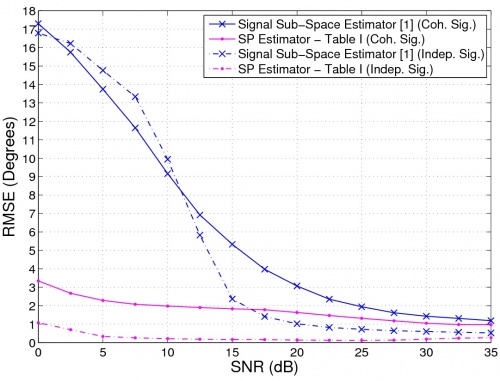
Simulation results are presented, for both fully correlated and uncorrelated signals impinging on a Uniform Linear Array (ULA), which demonstrate that the proposed technique performs robustly in low SNR regions, where the ML and orthogonally projected SS techniques suffer from the threshold effect. Figure 1 gives one set of the presented results for the case of 3 Gaussian signals impinging on a 6-element ULA, where 500 temporal samples are assumed available.
Go to Journal